


8 Mins
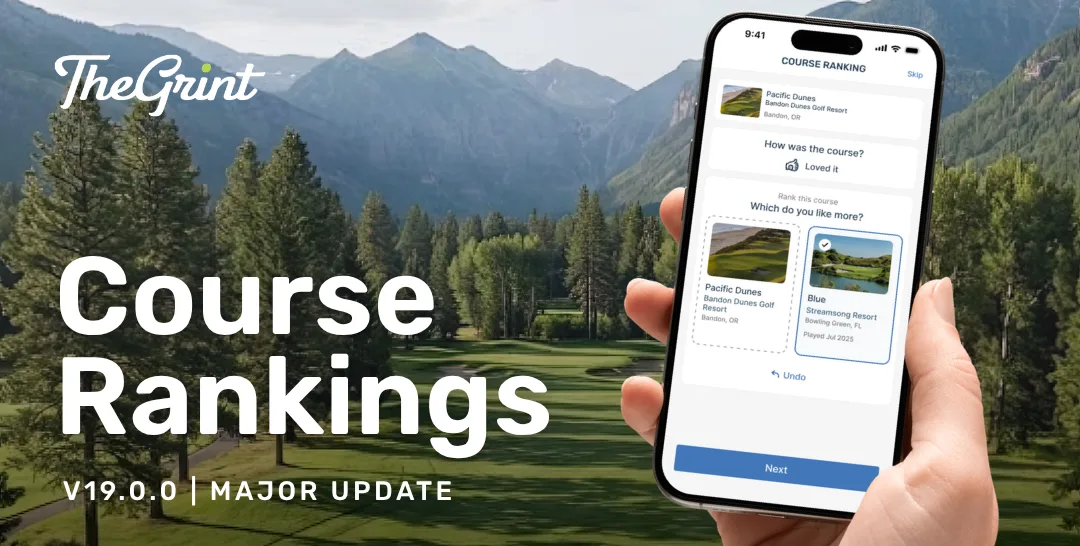
One of the more interesting things we've learned over the years at TheGrint is that golfers love ranking golf courses.
We know this because they've been doing it on our platform for a long time.
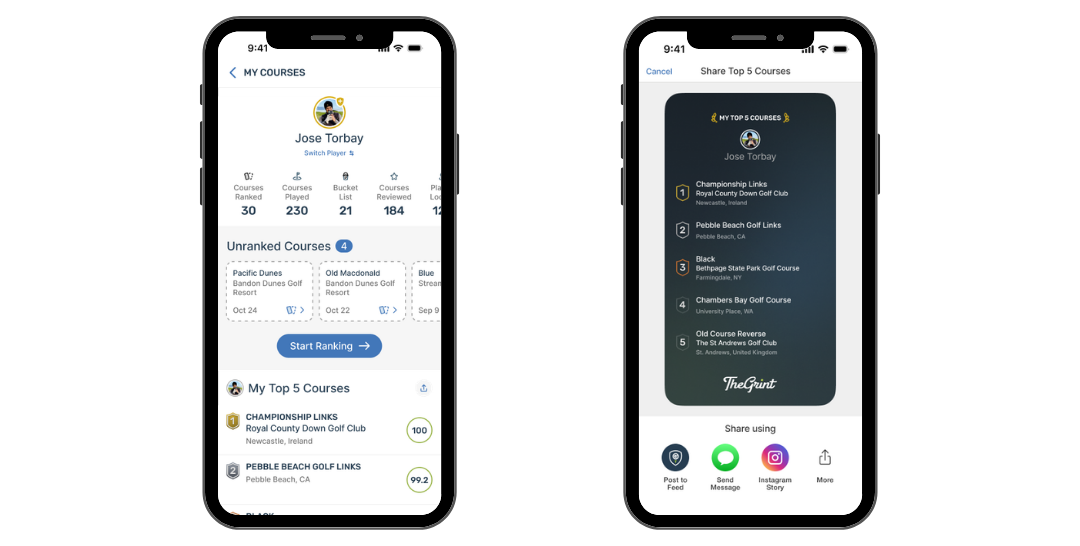
For years, TheGrint has allowed golfers to build personal rankings lists of every course they've played. We've accumulated what is probably one of the largest golf course review and ratings databases on the planet, with millions of reviews, as well as millions of personally curated lists of ranked courses. Those rankings now power TheGrint Top 100, five lists of the best golf courses as ranked by golfers.
Some golfers use it as a bucket-list tracker. Others use it to settle endless debates with friends. For many, it's simply a fun way to document their golfing journey.
The feature has been popular, but we've always felt there was a problem with how course rankings worked across not only TheGrint, but the golf industry as a whole.
Most ranking systems ask golfers to do one of two things: assign a numerical rating to a course or manually place it somewhere within a ranked list.
At first glance, both approaches seem reasonable. In practice, they're surprisingly difficult.
Let's say you just played a new course and want to add it to your rankings. Where exactly does it belong?
Is it better than your 12th-ranked course? Worse than your 18th-ranked course? Does it belong in your top 10? Your top 25?
Now imagine you've played 100 courses. Suddenly you're not evaluating a golf course anymore. You're trying to solve a puzzle.
The deeper we looked at this problem, the more we realized something important: golfers don't naturally think about courses this way.
When golfers talk about golf courses, they don't usually discuss whether a course deserves an 8.2 versus an 8.6 rating. They don't spend much time debating whether a course belongs exactly 37th or 42nd on a list.
Instead, golfers compare.
They compare experiences.
They compare memories.
They compare courses against one another.
Ask a golfer if a course belongs at number 27 on their list and they'll probably need a few minutes to think about it.
Ask them whether they'd rather play Course A or Course B next weekend and they'll usually have an answer immediately.
That observation became the foundation for a complete redesign of Course Rankings on TheGrint. And we anchor it around the concept of "If you had only one round left to play between Course A and Course B, which would you choose to play?"
Watch this video here to see the new feature in action. Or, keep reading to learn more about how it works.
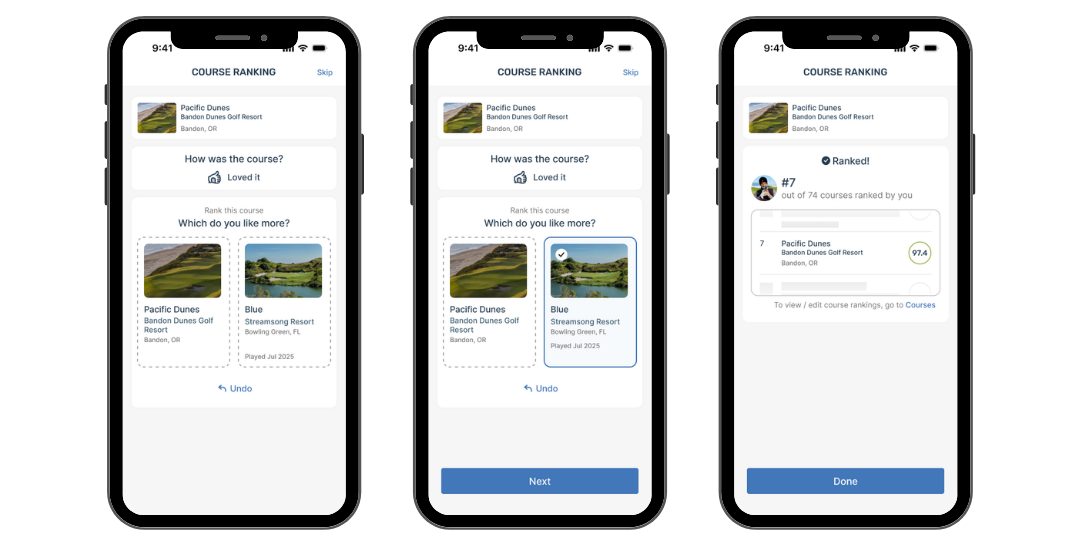
Rather than asking golfers to manually organize long lists of courses, we've rebuilt Course Rankings around a simple head-to-head format.
When you add a course to your rankings, TheGrint will present two courses side by side and ask a simple question:
Which course do you prefer?
Select a winner and move on. The system then presents another comparison.
And another.
And another.
With each decision, TheGrint learns more about where that course belongs within your personal rankings.
If a course beats another course that currently sits near the top of your list, it moves upward. If it loses to several highly ranked courses, it settles lower. The process continues until we can confidently determine where that course belongs relative to the rest of your rankings - usually after 3-5 head to head comparisons depending on how large your course portfolio is.
Instead of manually dragging a course through dozens or hundreds of positions, you're simply making a series of decisions that feel natural and intuitive. And yes - you can still manually tweak a list at the end to massage it to your liking.
The result is a ranking process that requires less effort while often producing a more accurate outcome.
The challenge with traditional ratings is that they're highly dependent on context.
Consider a course like Poppy Hills. It is an EXCELLENT golf course. And for one golfer, it might be a perfect 10 out of 10 experience.
But for another golfer who spent the previous week playing Pebble Beach, Cypress Point, and Spyglass Hill, the rating might be considerably lower.
Neither golfer is wrong.
The problem is that a numerical score struggles to capture relative preference.
Golf courses are unique because golfers rarely evaluate them in isolation. Every new course is unconsciously compared against every course that golfer has already played.
A head-to-head comparison embraces that reality rather than fighting it.
Instead of asking golfers to assign an abstract score, we're simply asking them to make the comparison they were already making in their heads.
In many ways, it's less about rating courses and more about discovering your own preferences.
One of the most interesting things we noticed while testing the new system was how often golfers continued ranking long after they intended to stop.
Someone would add a recently played course.
Then they'd see another matchup. Then another.
Before long, they were revisiting courses they hadn't thought about in years, challenging old assumptions, and refining rankings they had originally created months ago.
The process feels less like filling out a form and more like playing a game.
That's important because ranking courses should be enjoyable.
Golfers are passionate about the places they've played. Some of their favorite golf memories are tied to those courses. Building a personal ranking shouldn't feel like administrative work.
It should feel like reliving those experiences.
While the immediate benefit is a better experience for individual golfers, there's a larger opportunity behind the scenes.
TheGrint sits on one of the largest collections of golf course data in the world. Millions of golfers have tracked tens of millions of rounds on the platform. They've rated courses, built personal rankings, created bucket lists, and documented their experiences across thousands of golf facilities.
The new Course Ranking Game gives us an even richer understanding of how golfers compare courses relative to one another.
Not just whether golfers enjoyed a course, but how they rank it against every other course they've experienced.
That distinction becomes incredibly powerful at scale.
It helps surface hidden gems. It helps identify courses that consistently outperform expectations. And it helps create a more authentic picture of how golfers actually view the golf landscape.
Those insights ultimately become useful far beyond rankings themselves.
Because once you understand how golfers compare courses, you can start helping golfers discover the right courses in the first place.
That's exactly what led to the next piece of this release.


