



TheGrint HQ

6 minutes
Updated
October 26, 2026

Slope in golf is the Slope Rating™, a number from 55 to 155 that shows how much harder a set of tees plays for a bogey golfer than for a scratch golfer. The standard is 113. The higher the number, the more handicap strokes you get from those tees, because the course punishes higher handicaps more.
This guide explains what slope measures, how it differs from the Course Rating™, what counts as a high or low slope, and how slope changes the strokes you get, with a worked example.
You can look up the scorecard for more than 37,000 courses free in TheGrint's golf course directory, and TheGrint works out your strokes for the tees you play.
Slope is a measure of how much harder a course plays for a bogey golfer than for a scratch golfer, from a specific set of tees. Under the World Handicap System™, every rated set of tees gets its own Slope Rating, on a scale from 55 to 155.
Slope doesn't tell you how hard a course is for a scratch golfer. That's what the Course Rating does.
The Course Rating is the score a scratch golfer is expected to shoot from a set of tees in normal conditions, shown to one decimal place. The Slope Rating is how much harder those same tees play for a bogey golfer, relative to a scratch golfer.
| Course Rating | Slope Rating | |
|---|---|---|
| What it measures | Difficulty for a scratch golfer | Extra difficulty for a bogey golfer compared with a scratch golfer |
| Shown as | A score to one decimal, close to par | A whole number from 55 to 155 |
| Standard | Near the course's par | 113 |
| Changes by | Set of tees | Set of tees |
A third number, the Bogey Rating™, is the expected score for a bogey golfer. The Slope Rating comes from the gap between the Bogey Rating and the Course Rating, so the bigger that gap, the higher the slope. Together, Course Rating and Slope Rating are often called the Ratings for a set of tees.
There's no good or bad slope, only higher or lower. A slope near 113 means a course of standard relative difficulty; above it, higher handicaps lose more strokes to better players. As a rough guide:
If you're choosing between tees, slope is only part of the story. Yardage matters too: our guide on what tees to play matches course length to your driving distance.
Slope turns your Handicap Index® into a Course Handicap™, the number of strokes you get from a specific set of tees. A higher slope gives you more strokes, because the course plays harder for your level than standard.
The formula from the Rules of Handicapping is:
Course Handicap = Handicap Index × (Slope Rating ÷ 113) + (Course Rating − par)
Here's an example with made-up numbers. A golfer with a Handicap Index of 15.0 plays a set of tees with a Slope Rating of 130, a Course Rating of 72.5 and a par of 72:
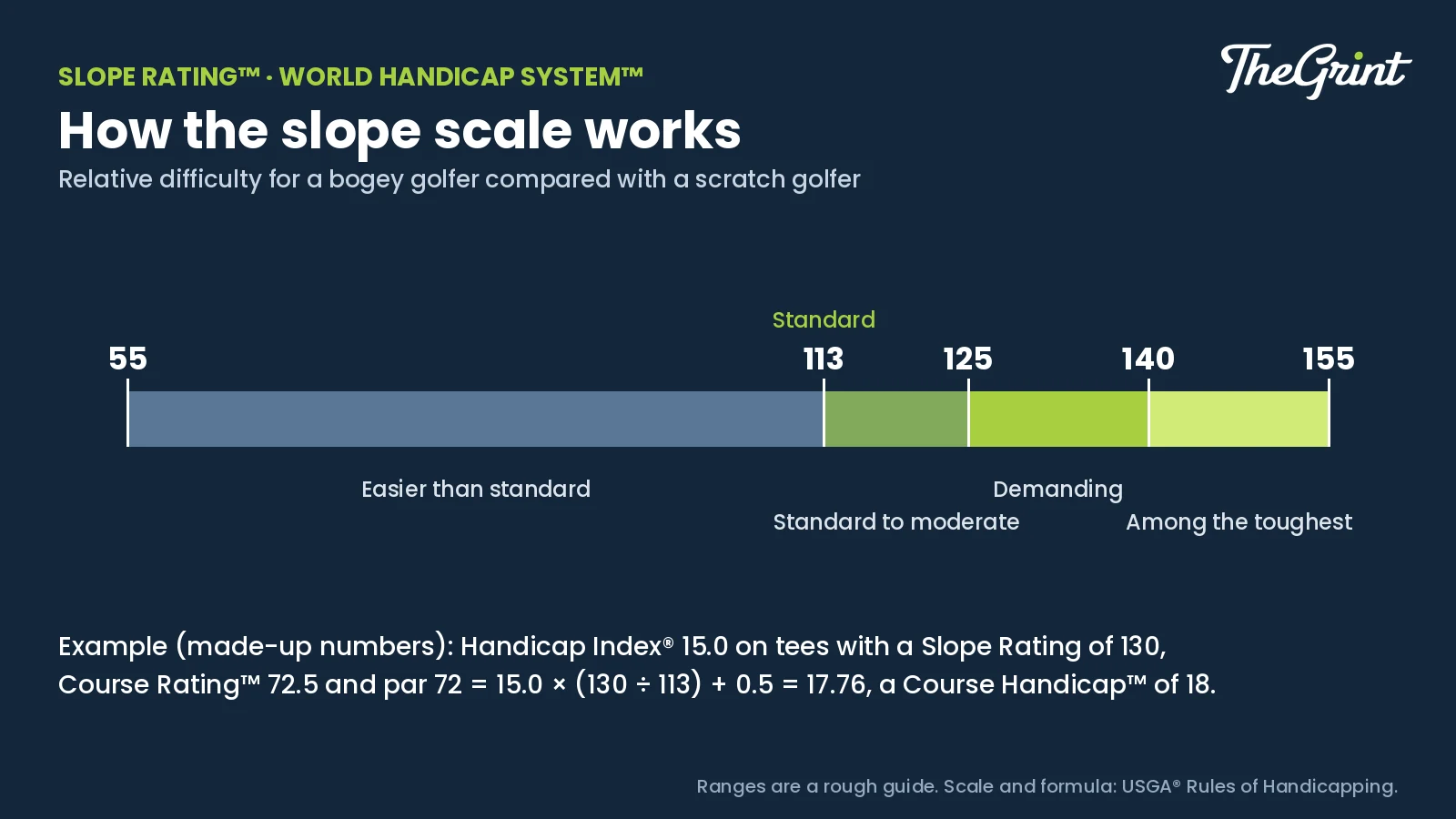
From a set of tees with the standard slope of 113 and a Course Rating equal to par, the same golfer's Course Handicap would be 15. In competitions, a handicap allowance can then turn the Course Handicap into a Playing Handicap™.
In the U.S., trained rating teams from the Allied Golf Associations rate courses under the Course Rating System™ that the USGA® and The R&A run. Raters measure each hole and assess obstacles such as rough, bunkers, water, trees and green speed, for both a scratch and a bogey golfer.
Courses are re-rated from time to time, especially after changes such as new tees or redesigned holes. That's why the Ratings on an old scorecard can differ from the current ones.
Not exactly. Slope is an official measure of relative difficulty from a rating team's assessment. TheGrint Difficulty is a separate, data-based measure: it shows how hard a course plays compared with every other rated course on TheGrint, based on the scores golfers actually log there.
The two often point the same way, but not always. On TheGrint, Erin Hills plays harder than 99% of rated courses, while Mammoth Dunes, another Top 100 course in Wisconsin, plays harder than only 43%. For more, see the hardest golf courses golfers rank among the best.
Slope matters every time you post a score: the Ratings for the tees you played go into that round's Score Differential™, which feeds your handicap.
Slope, or Slope Rating, measures how much harder a set of tees plays for a bogey golfer than for a scratch golfer. It runs from 55 to 155, with 113 as the standard. A higher slope means the course is relatively harder for higher handicaps, so you receive more strokes from those tees.
The standard Slope Rating is 113, which represents a course of standard relative difficulty. Individual tees can be rated anywhere from 55 to 155. Back tees usually have a higher slope than forward tees on the same course, so the slope you play depends on which tees you choose.
Yes, for higher-handicap golfers. A higher Slope Rating means a bogey golfer loses more strokes to a scratch golfer on that course. To make up for it, a higher slope gives you a higher Course Handicap, so you receive more strokes and your net score stays comparable across courses.
The Course Rating is the expected score for a scratch golfer from a set of tees, shown to one decimal. The Slope Rating shows how much harder those tees play for a bogey golfer relative to a scratch golfer, on a scale from 55 to 155. Both feed into your Course Handicap.
Multiply your Handicap Index by the Slope Rating divided by 113, then add the Course Rating minus par. For example, a 15.0 Handicap Index on tees rated 72.5 with a slope of 130 and a par of 72 gives 17.76, which rounds to a Course Handicap of 18.
Look up the course, pick your tees and let TheGrint handle the strokes, with free GPS distances, live scoring and games for your group. Get started with TheGrint.
World Handicap System™, Handicap Index®, Score Differential™, Course Handicap™, Playing Handicap™, Course Rating™, Slope Rating™, Bogey Rating™, Course Rating System™ and related marks are owned or licensed by the United States Golf Association® (USGA®) and/or The R&A. All rights reserved.


