



TheGrint HQ

6 minutes
Updated
October 22, 2026
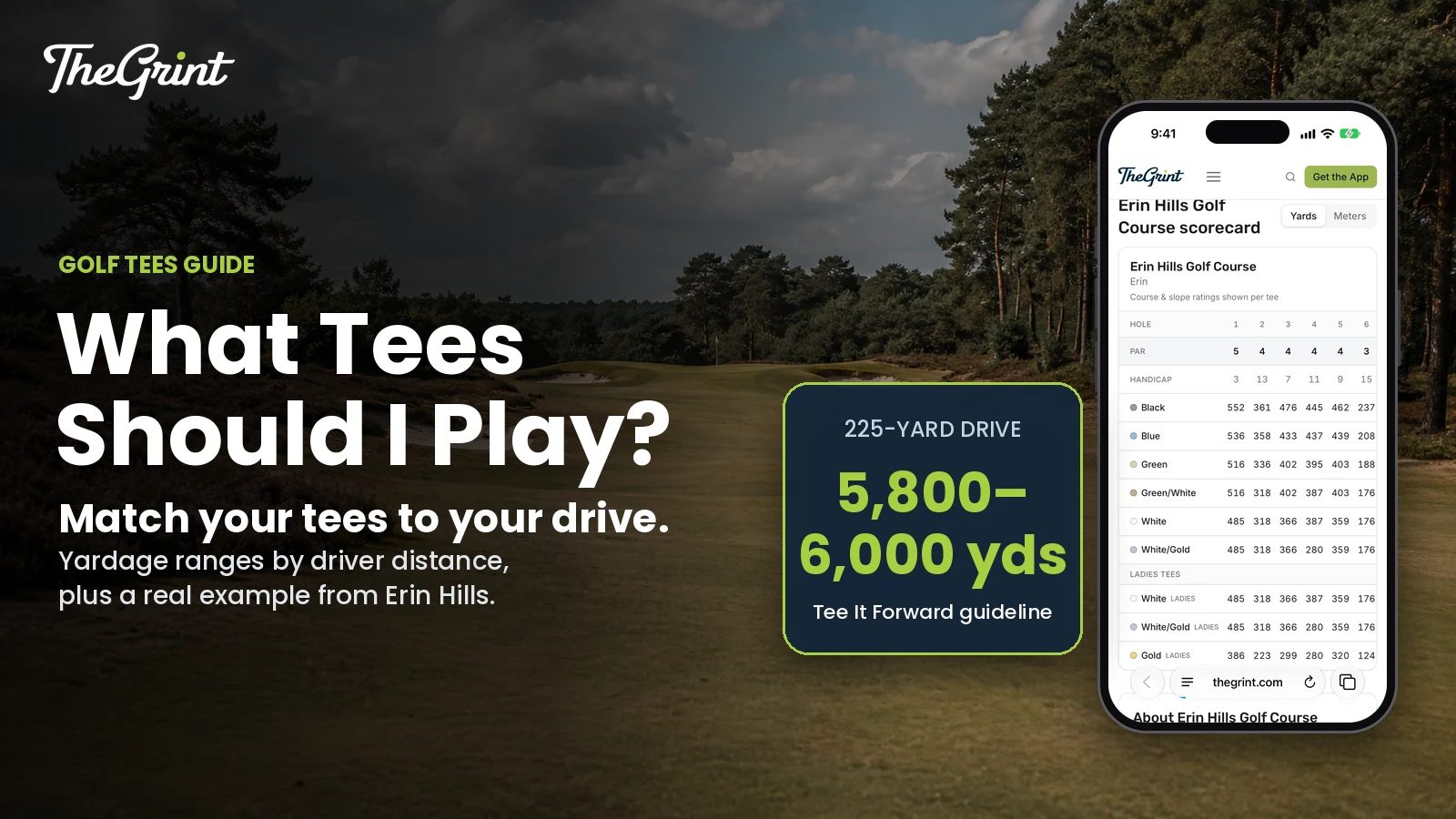
Play the tees whose total yardage matches how far you hit your driver. The Tee It Forward guidelines from the USGA® and the PGA of America suggest a 6,200- to 6,400-yard course for a 250-yard driver and 5,800 to 6,000 yards for a 225-yard driver. If you average less than 225 yards, play a course under 6,000 yards.
This guide shows how to match your tees to your driving distance, what tee colors mean, and how it works on a real course: Erin Hills, No. 1 on TheGrint's 2026 Top 100 U.S. Public list, which has tees from 5,078 to 7,772 yards.
You can compare the tee yardages for more than 37,000 courses free in TheGrint's golf course directory, and TheGrint gives you free GPS distances once you're on the tee.
Play the set of tees whose 18-hole yardage falls in the range for your average driver distance. That's the idea behind Tee It Forward, which the USGA and the PGA of America launched in 2011 to get golfers playing courses that fit their game.
| Average driver distance | Recommended 18-hole yardage |
|---|---|
| 300 yards | 7,150 to 7,400 |
| 275 yards | 6,700 to 6,900 |
| 250 yards | 6,200 to 6,400 |
| 225 yards | 5,800 to 6,000 |
| 200 yards | 5,200 to 5,400 |
| 175 yards | 4,400 to 4,600 |
| 150 yards | 3,500 to 3,700 |
| 125 yards | 2,800 to 3,000 |
| 100 yards | 2,100 to 2,300 |
Use your real average, not your best drive. Count the drives that go in the trees and the ones you top, too. If you fall between two rows, start with the shorter tees: you can always move back next time.
Your driver distance is how far your typical drive travels, including roll, on the course. The easiest way to find it is to check a few rounds' worth of drives rather than one range session.
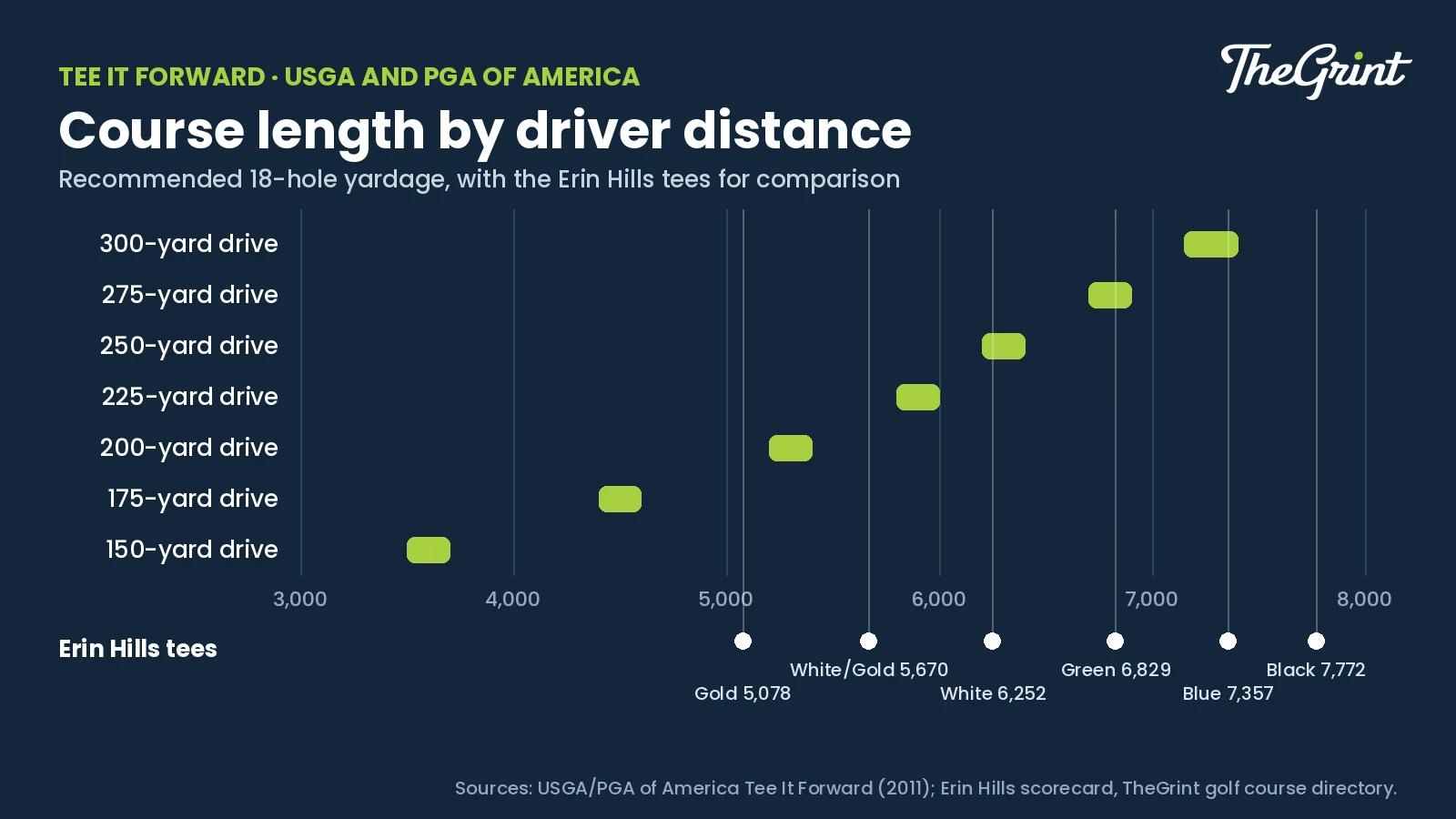
Look up the course's scorecard, find the total yardage for each set of tees and pick the one in your range. Here's how the Tee It Forward ranges line up with the seven sets of tees at Erin Hills, from its page in TheGrint's directory:
| Erin Hills tees | 18-hole yardage | Fits a driver distance of about |
|---|---|---|
| Black | 7,772 | Longer than 300 yards |
| Blue | 7,357 | 300 yards |
| Green | 6,829 | 275 yards |
| Green/White | 6,537 | 250 to 275 yards |
| White | 6,252 | 250 yards |
| White/Gold | 5,670 | 200 to 225 yards |
| Gold | 5,078 | 200 yards or less |
A golfer who drives it 225 yards would be looking at the White/Gold tees, not the White tees most groups default to. That's almost 600 yards shorter, which is the difference between hybrids and wedges into many greens.
Course difficulty matters too. Erin Hills plays harder than 99% of rated courses on TheGrint, based on golfers' scores, so on a course that hard, it's worth moving up. Every course page in the directory shows TheGrint Difficulty next to the scorecard. See the hardest golf courses golfers rank among the best for more.
Tee colors don't have a universal meaning. Each course chooses its own colors or names, so the only reliable guide is the yardage on the scorecard. That said, most courses follow a loose pattern:
Don't choose by color alone. White tees at one course can be several hundred yards longer than at another, and some courses use names instead of colors. Our guide on how to read a golf scorecard shows where to find each set's yardage.
No, not in a way that hurts you. Your scores count toward your handicap from any set of tees that has been rated, and the rating adjusts for how hard each set plays.
When you move up a set of tees, your Course Handicap™ for that round usually goes down, because the shorter course plays easier. The adjustment works both ways, so your net score reflects how well you played those tees. To learn how the numbers fit together, read what a golf handicap is.
Move up when you regularly need a fairway wood or long iron for your second shot on most par 4s. That's the clearest sign the course is playing longer than it should for your game.
TheGrint shows you the yardage before the round and the distances during it. Every course page in the directory has an Open in TheGrint button.
Beginners should play the forward tees, usually the shortest set on the scorecard. Under the Tee It Forward guidelines, a golfer who drives the ball 175 yards should play a course of about 4,400 to 4,600 yards. Starting short means more greens within reach and faster rounds, and you can move back as you improve.
Tee colors have no universal meaning; each course picks its own. Back tees are often black, gold or blue, middle tees blue or white, and forward tees gold, green or red. Combo tees, like Green/White, mix two sets. Always compare the total yardage on the scorecard instead of going by color.
Combo tees mix holes from two sets of tees to create a length in between them. At Erin Hills, the Green/White combo plays 6,537 yards, between the Green tees at 6,829 and the White tees at 6,252. The scorecard lists combo tees as their own row, with their own yardage for every hole.
Your scores count toward your handicap from any rated set of tees. Moving up usually lowers your Course Handicap for that round because the shorter course plays easier, and the adjustment keeps your net score fair. That way, scores from different tees compare fairly.
A golfer who averages 200 yards off the tee should play a course of about 5,200 to 5,400 yards, according to the Tee It Forward guidelines from the USGA and the PGA of America. Look for the set of tees closest to that total on the course's scorecard; at Erin Hills, that's the Gold tees.
Look up the course, compare every set of tees and pick the one that fits your drive, then keep score in TheGrint with free GPS distances, live scoring and games for your group. Get started with TheGrint.
Course Handicap™ is owned or licensed by the United States Golf Association® (USGA®) and/or The R&A. All rights reserved.


