
TheGrint HQ

11 minutes
Updated
October 20, 2026
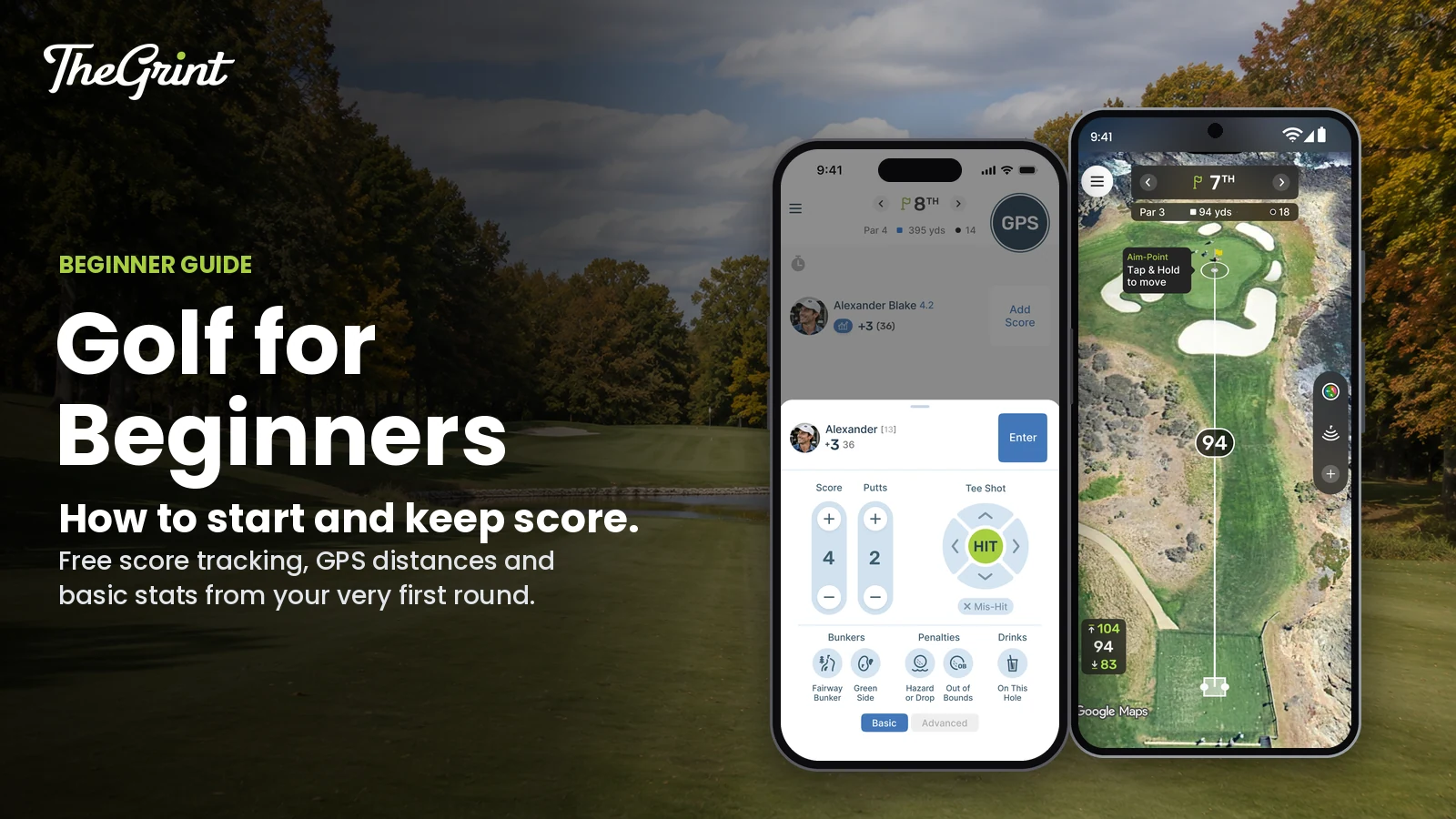
Golf for beginners starts with less than most people think: a few clubs, a sleeve of balls, some tees, a place to practice, the basics of etiquette and a way to keep score. You don't need a full set or a membership. If you track your score from your very first round, you'll be able to see yourself getting better.
This guide covers the beginner golf tips that matter most: which clubs to start with, where to play your first holes, how to keep score in golf, the golf terms beginners hear most, etiquette and pace of play, what to track first, how a handicap works and a few easy games to play with friends.
If you'd like to keep score on your phone from day one, TheGrint gives every golfer free score tracking, GPS distances and basic stats.
To start playing golf you need a handful of clubs, golf balls, tees, comfortable clothes and shoes, a place to practice and a way to keep score. Everything else can wait.
A beginner can start with a half set of about seven clubs: something easy to hit off the tee, a few irons, a wedge and a putter. Using the same few clubs over and over is how you learn what each one does.
Under Rule 4.1b of the Rules of Golf, a player must not "start a round with more than 14 clubs" or have more than 14 during the round (R&A, Rules of Golf, Rule 4). A beginner set will be well under that limit.
Most beginners should start at a driving range, then move to a short course or par-3 course before playing a full 18 holes.
Lessons help too. A golf professional at your local course or range can teach grip, stance and swing basics, and good habits are easier to build early. TheGrint doesn't offer lessons; it is where you keep score and track your progress once you're playing.
You keep score in golf by counting every stroke you take on each hole, including penalty strokes, and writing that number down for the hole. Each hole has a par, the number of strokes a skilled golfer is expected to need, and your score on a hole is named by how it compares with par.
Par, birdie and bogey describe your score on a hole compared with its par. These are the golf terms for beginners that you'll hear on every hole:
| Term | Score vs. par | Example on a par 4 |
|---|---|---|
| Eagle | 2 under par | 2 |
| Birdie | 1 under par | 3 |
| Par | Even with par | 4 |
| Bogey | 1 over par | 5 |
| Double bogey | 2 over par | 6 |
| Triple bogey | 3 over par | 7 |
Double and triple bogeys are normal at first. A bogey is a good hole for a new golfer, and your first par is worth celebrating.
In stroke play the lowest total for the round wins; in match play you compete hole by hole. The Rules of Golf put stroke play simply: "the player who completes all rounds in the fewest total strokes (including strokes made and penalty strokes) is the winner" (R&A, Rules of Golf, Rule 3).
In match play, you win the match once you lead by more holes than remain. A bad hole costs you only that hole, which makes match play more forgiving for beginners.
Stableford is good for beginners because it awards points on each hole instead of counting total strokes, so a disaster hole scores zero points and you move on. On TheGrint's classic table, a par earns 2 points, a bogey 1, and a double bogey or worse 0.
The Rules of Golf even encourage players to stop once they can no longer score a point on a hole (R&A, Rules of Golf, Rule 21), which helps beginners keep pace. Our guide to the Stableford scoring system has the full points table.
Once you have a Handicap Index®, the most you count on any hole for handicap purposes is net double bogey. The USGA® defines it as "a score equal to the par of a hole plus two strokes and adjusted for any handicap strokes applied on that hole" (Rules of Handicapping, Definitions).
Before you have a Handicap Index, the limit is different: for the first scores you post, "the maximum score for each hole played is limited to par + 5 strokes" (R&A, Rules of Handicapping, Rule 3.1). Either way, write down your real score; the cap is applied for handicap purposes only.
Beyond par and its cousins, a few golf terms come up in almost every round:
Golf etiquette for beginners comes down to three things: keep a prompt pace, look out for other people's safety, and take care of the course. Rule 1.2a of the Rules of Golf asks players to show "consideration to others – for example, by playing at a prompt pace, looking out for the safety of others, and not distracting the play of another player" (R&A, Rules of Golf, Rule 1).
On a paper scorecard you write your strokes for each hole in a box and add them up at the end of each nine; in an app you tap in your score hole by hole and the totals, stats and handicap math are done for you. Both count every stroke the same way.
| Paper scorecard | Scoring app | |
|---|---|---|
| Totals | Add each nine yourself | Calculated as you go |
| Putts and fairways | Extra marks in the margin | Tapped in with each hole |
| Stats over time | Kept in your own notes | Built from every round you track |
| Maximum hole score | Worked out by hand | Can be applied for you |
A paper card is fine for a first round. An app pays off after a few rounds, when you can compare them side by side.
Beginners should track three things first: their score on each hole, their putts and whether their tee shot found the fairway. Together they show where your strokes go.
Once those become habit, add greens in regulation. On TheGrint you don't enter GIR at all: the app calculates it from your score and putts, marking a GIR when your score minus your putts equals par minus two, so a par on a par 4 with two putts counts as one.
Tracking from your first round gives you a record, and watching your average drop is one of the best reasons to keep playing.
Beginners don't need an official golf handicap to play, but a handicap becomes useful once you want to play fair net games with friends or enter events. Until then, an estimated handicap is enough to see your level and choose the right tees.
A handicap lets golfers of different levels compete on even terms; our guide to what a golf handicap is explains how.
For the full process, see our step-by-step guide to getting an official golf handicap, and how handicaps work on TheGrint.
The best golf games for beginners are points-based formats where one bad hole doesn't ruin the round: Stableford, Skins and Best Ball.
Played net, with handicaps, these games let mixed-ability groups compete closely. On TheGrint, all three are among the six games every member can play, and the app keeps the points updated as you enter each hole. See all the games on TheGrint.
TheGrint gives beginners free GPS distances, free hole-by-hole scoring and stats, an estimated handicap and six games to play with friends, so you can track every round from the start without paying anything. TheGrint is free, always, and trusted by millions of golfers.
When you want more, a Pro Membership on TheGrint adds 50+ performance stats, Insights & Targets that compare your game with golfers at a similar level, score tracking on a supported smartwatch, and Green Maps showing the slope and break of the green. See what Free and Pro include. For more advanced features, try TheGrint Pro free for 7 days.
It depends on how often you play and practice, and on what "good" means to you. Regular play and short, focused practice sessions usually speed things up. Set small goals, such as fewer three-putts or breaking 100, and track every round so you can see the progress instead of guessing.
A good score for a beginner is one that is better than your last one. Many new golfers set breaking 100 for 18 holes as their first big goal, then 90. On a par-72 course, 100 means averaging about one and a half strokes over par per hole. Playing the forward tees makes those goals more realistic.
You can carry up to 14 clubs in golf. Rule 4.1b of the Rules of Golf says a player must not start a round with more than 14 clubs or have more than 14 during the round. There is no minimum beyond what you need to play, so a beginner's half set of about seven clubs is fine.
No. You can play casual rounds without any handicap. An official Handicap Index becomes useful when you want fair net games or want to enter events that require one. To establish one in the U.S., you post at least 54 holes of scores, which can be three 18-hole rounds or a mix of 9-hole and 18-hole rounds.
Download TheGrint before your first round, start a round when you reach the first tee, and tap in your score and putts on each hole. Your scores, stats and estimated handicap build from there, with free GPS on 40,000+ courses. Get TheGrint.
Handicap Index® and related marks are owned or licensed by the United States Golf Association® (USGA®) and/or The R&A. All rights reserved.


