
TheGrint HQ

10 minutes
Updated
October 1, 2026
Stableford scoring is a golf format where you earn points on each hole for your score against par instead of adding up strokes: 0 points for double bogey or worse, 1 for bogey, 2 for par, 3 for birdie, 4 for eagle and 5 for albatross. Most points wins, and a bad hole never scores below zero.
This guide covers the official points table, a hole-by-hole example, how net Stableford uses your handicap, what counts as a good score, and how the format changes for pairs and teams.
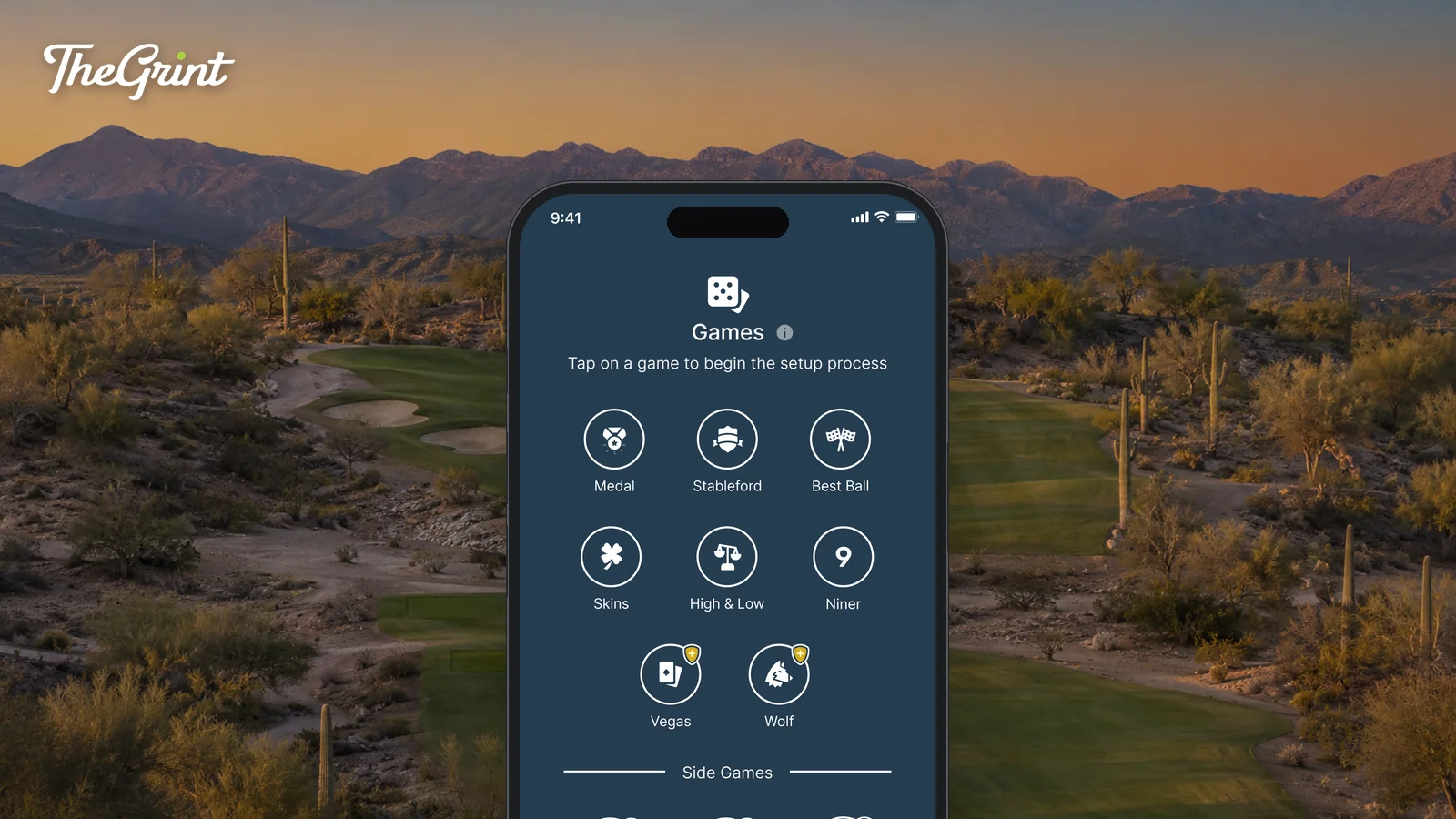
If you want the math done for you, TheGrint includes Stableford as one of the games every member can play and keeps the points updated as you enter each hole.
Stableford is a form of stroke play in which your score on each hole is turned into points, and the player with the most points at the end of the round wins. It is written into the Rules of Golf as Rule 21.1, alongside other alternative stroke-play formats such as Maximum Score and Par/Bogey (USGA®: Rules of Golf, Rule 21.1).
Points come from comparing your strokes on a hole, including penalty strokes, with a fixed target score. That target is par unless the Committee running the event sets a different one. Everything else in stroke play still applies: you play your own ball, count every stroke and follow the normal Rules.
The difference is what a bad hole does to you. In regular stroke play a 9 on a par 4 adds five strokes over par to your total. In Stableford it simply scores zero, the same as a double bogey, so you can pick up and move to the next tee.
You get 2 points for matching the target score on a hole, which is usually par, and one point more or less for each stroke better or worse, down to a floor of zero. The Rules of Golf set out the full table:
| Score on the hole | Name (when the target is par) | Points |
|---|---|---|
| More than one over, or no score returned | Double bogey or worse | 0 |
| One over | Bogey | 1 |
| Target score | Par | 2 |
| One under | Birdie | 3 |
| Two under | Eagle | 4 |
| Three under | Albatross (double eagle) | 5 |
| Four under | Condor | 6 |
Source: Rules of Golf, Rule 21.1b. A player who does not hole out, for any reason, gets zero points for that hole.
Two practical rules follow from the table:
You score Stableford by writing down your strokes on each hole as usual, then converting each hole into points and adding the points up. Here is one golfer's front nine, played without handicap strokes (gross Stableford):
| Hole | Par | Strokes | Result | Points |
|---|---|---|---|---|
| 1 | 4 | 5 | Bogey | 1 |
| 2 | 5 | 5 | Par | 2 |
| 3 | 3 | 4 | Bogey | 1 |
| 4 | 4 | 6 | Double bogey | 0 |
| 5 | 4 | 4 | Par | 2 |
| 6 | 3 | 2 | Birdie | 3 |
| 7 | 5 | 8 | Triple bogey | 0 |
| 8 | 4 | 4 | Par | 2 |
| 9 | 4 | 5 | Bogey | 1 |
| Total | 36 | 43 | 12 |
In stroke play this nine is a 43, seven over par. In Stableford it is 12 points. Notice holes 4 and 7: a double bogey and a triple bogey both score zero, so the triple costs this golfer nothing more than the double did.
To score any hole yourself:
In net Stableford you subtract your handicap strokes on each hole before converting the hole into points, so golfers of different abilities can compete on the same card. The Rules put this on the Committee: in a handicap competition, strokes are applied to the score entered for each hole and then the points are calculated (Rule 21.1b).
The strokes come from your Playing Handicap™. Start with your Course Handicap™, which converts your Handicap Index® for the tees you are playing (our guide to what a golf handicap is walks through that step). Then apply the handicap allowance for the format. The recommended handicap allowance for individual Stableford is 95% (Rules of Handicapping, Appendix C).
Here is how that works for a golfer with a Course Handicap of 18, the same player the USGA uses in its Appendix C example:
Run the same front nine through those strokes. Every hole on this nine has a stroke index of 17 or lower, so each one gets a stroke:
| Hole | Par | Strokes | Net score | Net result | Points |
|---|---|---|---|---|---|
| 1 | 4 | 5 | 4 | Net par | 2 |
| 2 | 5 | 5 | 4 | Net birdie | 3 |
| 3 | 3 | 4 | 3 | Net par | 2 |
| 4 | 4 | 6 | 5 | Net bogey | 1 |
| 5 | 4 | 4 | 3 | Net birdie | 3 |
| 6 | 3 | 2 | 1 | Net eagle | 4 |
| 7 | 5 | 8 | 7 | Net double bogey | 0 |
| 8 | 4 | 4 | 3 | Net birdie | 3 |
| 9 | 4 | 5 | 4 | Net par | 2 |
| Total | 36 | 43 | 34 | 20 |
The same 43 is worth 12 gross points and 20 net points. A golfer who receives two strokes on a hole, which happens once a Playing Handicap goes above 18, subtracts both before scoring it.
A good Stableford score is 36 points over 18 holes, because 36 means you averaged 2 points a hole, the same as making the target score on every hole. In net Stableford, 36 points means you played to your Playing Handicap.
Because of the 95% allowance, a golfer who plays exactly to their Course Handicap can finish a point or so under 36. For 9-hole Stableford, the equivalent target is 18 points. These benchmarks use the standard points table; on a scale that makes par worth 0, such as Stableford Modified on TheGrint, par golf scores 0.
Stableford and stroke play use the same golf and the same Rules; the difference is that stroke play totals every stroke while Stableford converts each hole into points and caps the damage of a bad hole at zero.
| Stroke play (Medal) | Stableford | |
|---|---|---|
| What counts | Total strokes for the round | Points earned on each hole |
| Winner | Lowest score | Highest points total |
| A blow-up hole | Every stroke counts | Scores 0 and you can pick up |
| Failing to hole out | Disqualification under Rule 3.3c | 0 points for that hole |
| Pace of play | Every hole played out | Faster, because players pick up |
| Recommended allowance (individual) | 95% | 95% |
That is why many clubs and groups choose Stableford for mixed-ability fields: a golfer who has one bad hole is still in the event, and the round moves quicker.
Modified Stableford is any version that swaps the Rule 21.1 table for a different points scale, often one that rewards birdies and eagles more and takes points away for bogeys or worse. On TheGrint, Stableford Modified gives 8 points for an albatross or better, 5 for an eagle, 2 for a birdie, 0 for a par, −1 for a bogey and −3 for double bogey or worse.
Because the scale changes from event to event, the event's own terms set the values. If you are joining one, check the points scale before you tee off.
Stableford works for pairs and teams too: Rule 21.1 is written for individual play but can be adapted for Four-Ball (Rule 23), Foursomes (Rule 22) and team competitions (Rule 24). The Committee's Terms of the Competition set how the points combine.
For other team formats, such as a two-person scramble, Appendix C lists different allowances, so check the format before you set strokes.
Stableford is one of the six games every golfer on TheGrint can play, Free or Pro, and the app calculates the points automatically as scores are entered hole by hole.
Games on TheGrint are points-based.
Net Stableford is only as fair as the handicaps behind it. If your group plays for a real net result, getting an official golf handicap gives everyone the same starting point. For the other formats you can play, see the games available to all members and how to play Wolf, Vegas and the other Pro games.
Yes. In Stableford the highest total wins, because you are adding up points rather than strokes. A par is worth 2 points and a birdie 3, so a golfer with 38 points beats one with 34, even if their stroke totals would have ranked them the other way round.
Yes. Once your score on a hole can only earn zero points, the Rules of Golf encourage you to stop playing the hole, which also keeps the round moving. You simply score zero points for that hole. On the scorecard you can leave the hole blank or enter any score that results in zero points.
No. Gross Stableford uses no handicap strokes, so anyone can play it. For net Stableford, where golfers of different abilities compete fairly, each player needs a handicap to set their strokes, and organized events usually require an official Handicap Index. Casual groups often use an estimated handicap instead.
Penalty strokes count exactly as they do in stroke play: they are added to your score for the hole before it is turned into points. The difference is the floor. However many penalty strokes you take, your score for a hole cannot go below zero points, and some breaches that would disqualify you in stroke play only cost you that hole.
A par is worth 2 points in Stableford, when par is the target score for the hole. A bogey is worth 1 point and a birdie 3. In net Stableford the same values apply to your net score, so a gross bogey on a hole where you receive a stroke counts as a net par and earns 2 points.
Start a round, tap Games and pick Stableford, add your group, and TheGrint keeps every player's points current hole by hole, with live leaderboards when you have more than one foursome. It is one of the six games every member gets. Get TheGrint.
Handicap Index®, Course Handicap™, Playing Handicap™ and related marks are owned or licensed by the United States Golf Association® (USGA®) and/or The R&A. All rights reserved.


