
TheGrint HQ

8 minutes
Updated
September 28, 2026
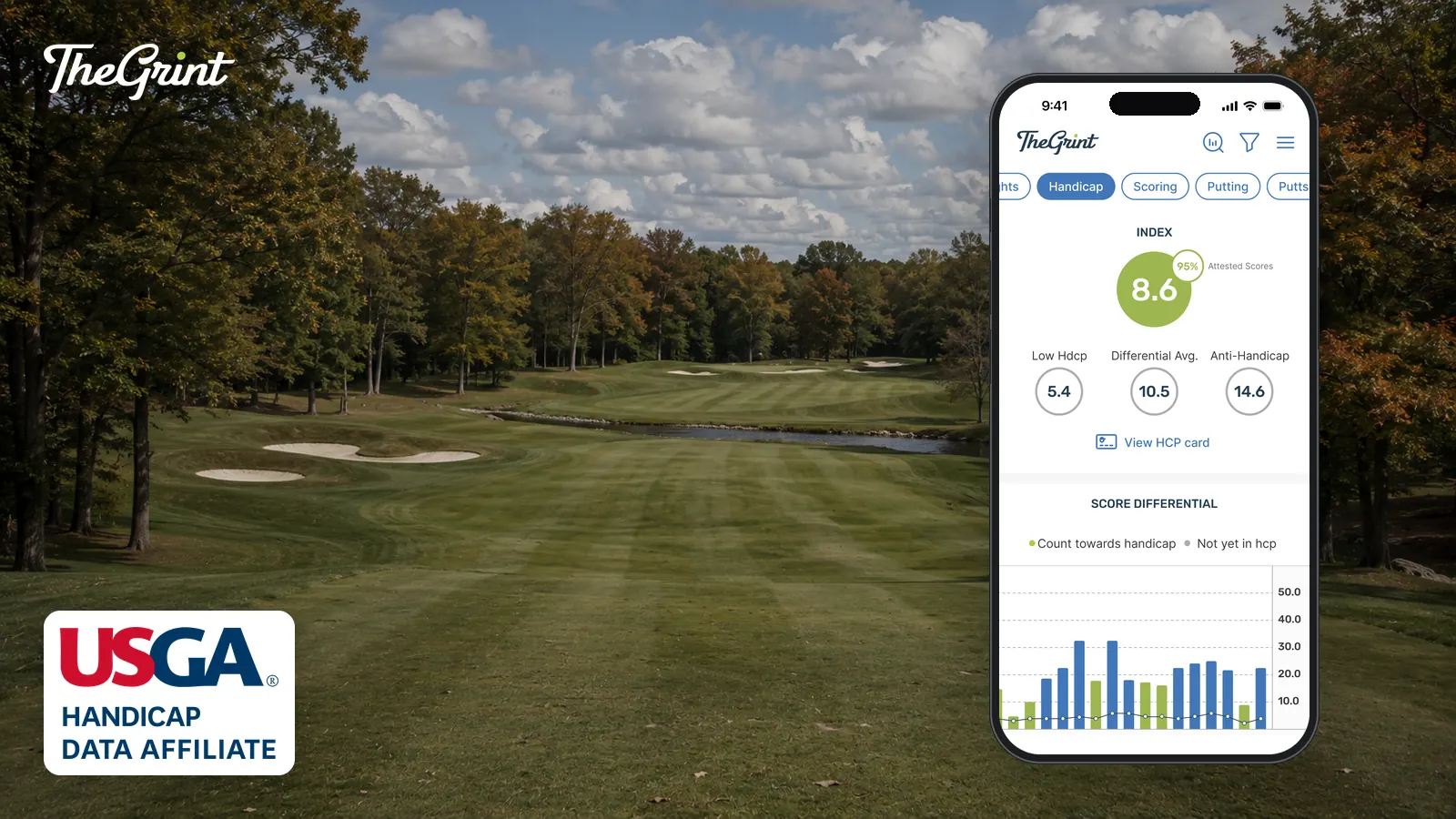
To get an official golf handicap in the United States, join a golf club authorized by your local Allied Golf Association, post scores from 54 holes in any mix of 9- and 18-hole rounds, and you have a Handicap Index® the next day. No private club membership is required, and the fee is set by your AGA.
This guide walks through the four steps, what an official handicap actually costs, what the USGA® means by a "golf club," how your Handicap Index is calculated once you have one, and what changes if you play outside the U.S. It also covers where TheGrint fits for golfers who want the handicap and the app in one place.
If you play in the United States, you can buy your official USGA Handicap ID inside TheGrint and post your scores from the same app. Here is how the whole process works.
An official golf handicap is a Handicap Index issued under the World Handicap System™ (WHS™) through an authorized golf club. In the United States, only the USGA calculates a Handicap Index, and it reaches you through your Allied Golf Association (AGA) and an authorized club. GHIN® is the USGA's technology service that holds your scoring record; it does not calculate the number. Whatever golfers call it, the official number has one name: Handicap Index.
The distinction matters because many apps, including TheGrint, can estimate your handicap from the scores you enter. That estimate is useful for choosing tees or setting up a friendly game, but it is not a Handicap Index, and a tournament committee will not accept it in place of one.
In TheGrint, Free members see an estimated handicap range such as 12~14, Pro members see a whole-number estimate such as 13, and a decimal figure like 12.7 appears only once you hold an official Handicap Index (or a GHAP handicap outside the U.S.).
The process is the same whether you go through a course, your AGA, or an app. The USGA sets the rules; the club or service you join is simply the place that administers them for you.

An official Handicap Index typically costs between about $40 and $85 per year, and the exact amount is set by your local Allied Golf Association rather than by the USGA or by any app. As the USGA's GHIN FAQ puts it, "the cost to join your local Allied Golf Association (AGA) and get a Handicap Index depends on your AGA."
Golfers in some states pay near the bottom of that range and golfers in others pay near the top, so treat any single nationwide figure quoted online with suspicion. The number to trust is the one your AGA publishes.
When you buy your Handicap ID through TheGrint, the price you pay is the price your AGA has set. TheGrint passes it through without adding a markup.
If you also want a Pro Membership on TheGrint, the Pro + USGA Handicap Bundle combines an annual Pro Membership with the official Handicap ID and takes $20 off the combined price, so the total is your AGA's handicap fee plus the $59.99 annual Pro price, minus $20.
Yes, but "golf club" does not mean a private course with a clubhouse. Under the Rules of Handicapping, a golf club is "an organization of at least 10 individual members that operates under bylaws with committees (including a Handicap Committee) to supervise golf activities, provide peer review and maintain the integrity of the World Handicap System" (USGA: Join the Club).
A club does not need to own or operate a course, and your local AGA can help you form one.
In practice, that gives you three ways to satisfy the requirement:
Whichever route you choose, peer review is the point. Your club's Handicap Committee can review your scoring record, which is what keeps handicaps honest and is the main reason an app-only estimate is not treated as official.
Your Handicap Index is the average of your best 8 Score Differential™ values from your most recent 20 scores. The USGA's World Handicap System FAQ states that "once you have 20 scores in your scoring record, your Handicap Index is calculated by first averaging the best 8 Score Differentials out of your most recent 20 scores." That value can then be adjusted by built-in safeguards, such as the reduction after an exceptional score and the soft and hard caps.
With at least three but fewer than 20 scores, fewer Score Differential values are used, which is why a Handicap Index can move quickly in your first season. The maximum Handicap Index is 54.0 for all players.
A Score Differential value is not your raw score. It accounts for the Course Rating and Slope Rating of the tees you played and for the day's playing conditions calculation, which is why an 83 on a hard course can help your Handicap Index more than an 82 on an easy one.
Each hole score is also capped at net double bogey before the round is used, so one disaster hole cannot wreck a Score Differential value.
If you want the arithmetic, see how to calculate a golf handicap, why an 83 may count toward your handicap but an 82 might not, and how scores are adjusted for handicap purposes.
Outside the U.S., the official handicap comes from your national golf union under the World Handicap System, and TheGrint does not integrate with those systems, including Golf Canada and England Golf. What TheGrint offers eligible golfers outside the U.S. instead is GHAP, the Golf Handicap for Amateurs Platform.
GHAP is a separate partner handicap network with its own methodology. It is not a Handicap Index under the World Handicap System, and it is not offered to U.S. golfers.
In TheGrint, GHAP comes with a one-month free trial, costs $9.99 per year after that, and is included with a Pro Membership for eligible golfers outside the United States.
TheGrint is built so the official handicap and the scoring app live in one place instead of two.
Once you belong to an authorized club, you need scores from 54 holes, which can be three 18-hole rounds, six 9-hole rounds, or any mix. Your Handicap Index appears the day after the score that completes the 54 holes is posted, so most golfers have one within a few weeks of starting.
Yes. The USGA requires membership in an authorized golf club, but that club can be a course club, a community club organized through your Allied Golf Association, or the club association you receive when you buy a Handicap ID through TheGrint. None of those require a private course membership.
Yes. The 54-hole requirement can be met with any combination of 9- and 18-hole rounds, and 9-hole scores continue to count afterward. Each score must be played on a course with a valid Course Rating and Slope Rating, and at least nine holes must be completed for the score to be acceptable.
No. GHIN is the USGA's technology service, and your GHIN number is the ID that identifies your scoring record within it. Your Handicap Index is the number the USGA calculates from that record. You use the GHIN number to link accounts and post scores; the Handicap Index is what you play with.
No. Free members see an estimated handicap range, such as 12~14, based on the scores they enter, and Pro members see a whole-number estimate. A decimal Handicap Index is shown only when you have linked or purchased an official Handicap ID, or hold a GHAP handicap outside the United States.
The maximum Handicap Index under the World Handicap System is 54.0 for all players. Your Course Handicap™ for a given set of tees can be higher or lower than your Handicap Index, because it adjusts the Handicap Index for that course's Slope Rating and Course Rating.
If you play in the United States, you can buy your official USGA Handicap ID inside TheGrint, link a GHIN you already have, and post every round from the same scorecard you use for GPS, stats, and games. Get started with TheGrint and post your first 54 holes.
World Handicap System™, WHS™, Handicap Index®, Score Differential™, Course Handicap™, Course Rating™ and Slope Rating™ are trademarks owned or licensed by the United States Golf Association® (USGA®) and/or The R&A. GHIN® is a registered trademark of the USGA. All rights reserved.


