



TheGrint HQ

7 minutes
Updated
October 30, 2026
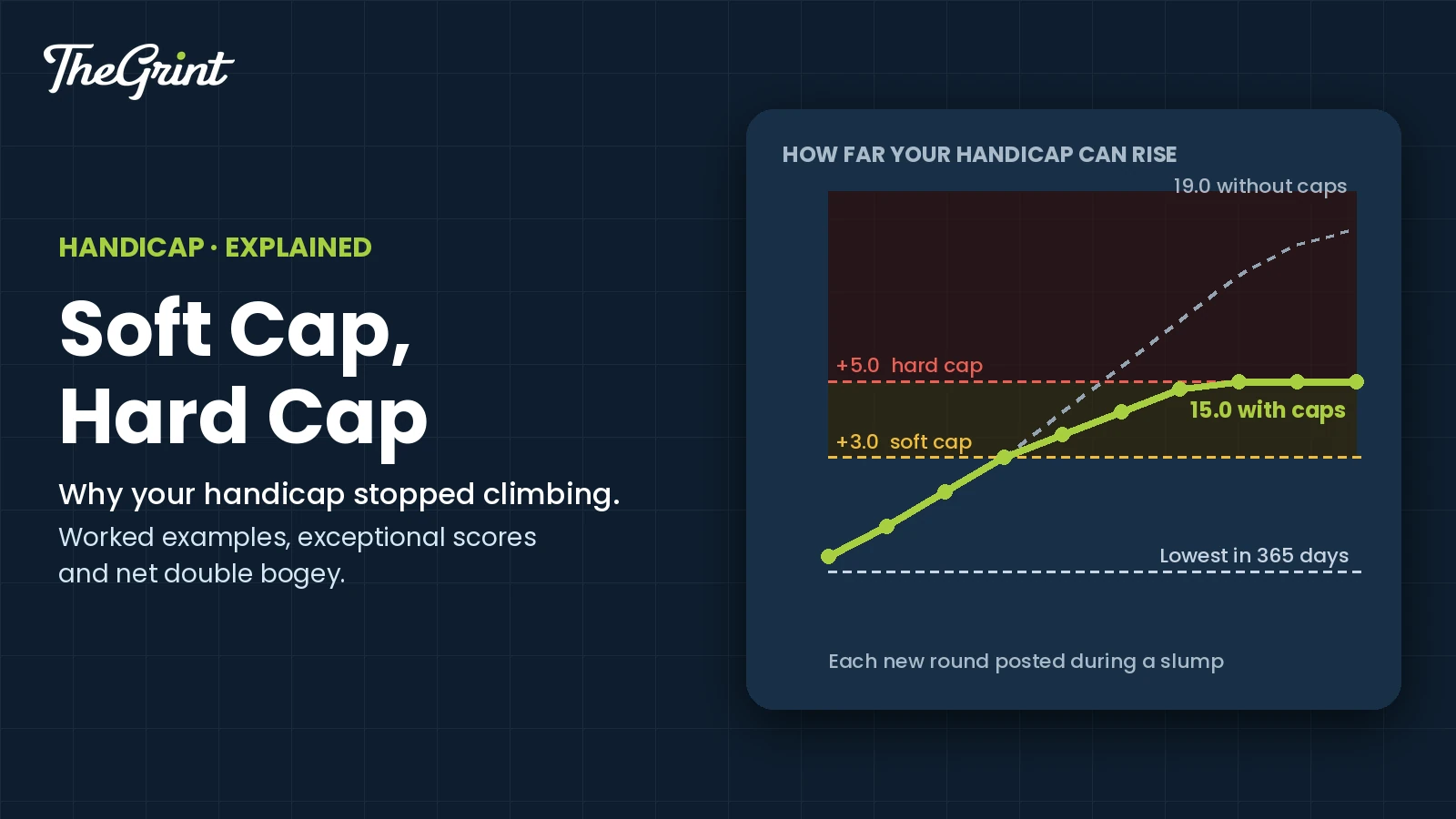
The soft cap and hard cap limit how fast your Handicap Index® can rise. Once a new Index would be more than 3.0 strokes above your Low Handicap Index™, only half of the increase beyond 3.0 counts (soft cap), and it can't go over 5.0 above it (hard cap). An exceptional score lowers your Index by 1.0 or 2.0.
These safeguards are part of the Rules of Handicapping, and golfers notice them most after a slump or a career round. This guide explains each one with worked numbers, plus net double bogey, the hole maximum that stops one blow-up hole from inflating a score.
If you have an official Handicap ID linked on TheGrint, your Handicap Index and Low Handicap Index sit side by side on the handicap screen, so you can see how close you are to a cap.
Your Low Handicap Index is the lowest Handicap Index you've had in the 365 days before the date of your most recent round. It's the reference point the caps compare your new Index against.
If you're new to the numbers, start with what a golf handicap is and how a Handicap Index is calculated.
The soft cap triggers when your newly calculated Handicap Index is more than 3.0 strokes above your Low Handicap Index. Any increase above 3.0 strokes is cut in half. Under 3.0, nothing changes.
The USGA® gives this example: a golfer has a Low Handicap Index of 10.0 and a new 8-of-20 calculation of 13.4. That's 3.4 strokes above the Low, so the extra 0.4 is halved to 0.2, and the Handicap Index becomes 13.2 instead of 13.4.
| Case | Low Handicap Index | Calculated Index | What happens | New Handicap Index |
|---|---|---|---|---|
| A slow slump | 10.0 | 12.6 | No cap (2.6 above Low) | 12.6 |
| Soft cap | 10.0 | 13.4 | 3.0 + half of 0.4 | 13.2 |
| Soft cap | 5.4 | 9.6 | 3.0 + half of 1.2 | 9.0 |
| Soft cap, then hard cap | 10.0 | 19.0 | Soft cap gives 16.0; hard cap stops at 15.0 | 15.0 |
In the third row, a Low Handicap Index of 5.4 means the soft cap starts to slow things down as soon as the Index would rise past 8.4.
The hard cap stops your Handicap Index from rising more than 5.0 strokes above your Low Handicap Index, after the soft cap has been applied. There is no limit in the other direction: an Index can drop as fast as your scores allow.
In the last row of the table, a golfer with a Low of 10.0 calculates to 19.0. The soft cap brings that to 16.0 (3.0 plus half of 6.0), and the hard cap then holds it at 15.0. The Handicap Committee at your golf club can override the caps when there's a reason, such as an injury or illness.
An exceptional score reduction lowers your Handicap Index after a round that is far better than your current Index. It applies when a Score Differential is at least 7.0 strokes lower than the Handicap Index you had when you played.
| Score Differential vs your Handicap Index | Reduction |
|---|---|
| 7.0 to 9.9 strokes better | -1.0 |
| 10.0 or more strokes better | -2.0 |
The reduction is applied to each of your most recent 20 Score Differential values, including the exceptional one. That means it stays in effect after your next score and fades as new scores replace the old ones. Two exceptional scores add together.
Example: you play to a 15.0 Handicap Index and post a round with a Score Differential of 6.2. That's 8.8 strokes better, so a 1.0 reduction is applied. If the Differential had been 4.8, 10.2 strokes better, the reduction would be 2.0. Source: USGA, exceptional score reduction.
If an app asks you to confirm a score that looks unusually low, check the hole scores and the tees, then post it if it's right. A real exceptional score still has to be posted.
Net double bogey is the most you can count on a single hole for handicap purposes: par, plus 2 strokes, plus any handicap strokes you receive on that hole based on your Course Handicap™. It keeps one disaster hole from inflating your Score Differential.
The caps limit how far and how fast a Handicap Index can climb, which also limits how much anyone can inflate one on purpose. But the main reason they exist is to keep a short slump from turning into a big jump, so an Index stays close to what a golfer has shown they can do.
The rest of the system adds checks. Exceptional scores pull an Index down quickly, the Handicap Committee can review a scoring record, and peer review lets golfers see each other's scores. On TheGrint, when a change to a score affects its scoring data, it is reposted to friends' feeds as EDITED or DELETED, and playing partners can attest a score. See why edited and deleted scores are marked.
The Handicap tab in TheGrint's stats shows your handicap next to Low Hdcp, your differential average and your Anti-Handicap, whether or not you have a linked or official Handicap ID. With one, the number is your official Handicap Index, and a round that triggered an exceptional score reduction is marked with an E in your scorecards list. Without one, Free members see an estimated handicap range and Pro members a whole-number estimate.
The soft cap slows down a rising Handicap Index. When a new Index would be more than 3.0 strokes above your Low Handicap Index, only 50% of the increase beyond 3.0 counts. For a golfer with a Low of 10.0 and a calculated 13.4, the Index becomes 13.2.
The hard cap stops a Handicap Index from going more than 5.0 strokes above your Low Handicap Index, after the soft cap is applied. A golfer with a Low of 10.0 can't have an Index above 15.0 until the Low Handicap Index itself changes, unless the Handicap Committee overrides it.
The soft cap and hard cap are measured against your Low Handicap Index, which looks back 365 days from your most recent round. As that window moves past the date of your lowest Index, the Low Handicap Index rises and the caps loosen. There is no fixed end date.
A score is exceptional when its Score Differential is at least 7.0 strokes lower than the Handicap Index you had when you played. A Differential 7.0 to 9.9 strokes better reduces your Index by 1.0, and 10.0 or more strokes better reduces it by 2.0, applied across your most recent 20 Differential values.
Either the round became one of your best 8 Score Differential values, or it was an exceptional score. An exceptional score, 7.0 or more strokes better than your Index, triggers an extra reduction of 1.0 or 2.0 that is applied to all of your most recent 20 Differential values.
Track every round in TheGrint, with free GPS distances and hole-by-hole scoring that applies net double bogey for you, and see your Handicap Index next to your Low Handicap Index. Get TheGrint.
Handicap Index®, Low Handicap Index™, Score Differential™ and Course Handicap™ are owned or licensed by the United States Golf Association® (USGA®) and/or The R&A. GHIN® is a registered trademark of the USGA. All rights reserved.


