
TheGrint HQ

7 minutes
Updated
October 7, 2026
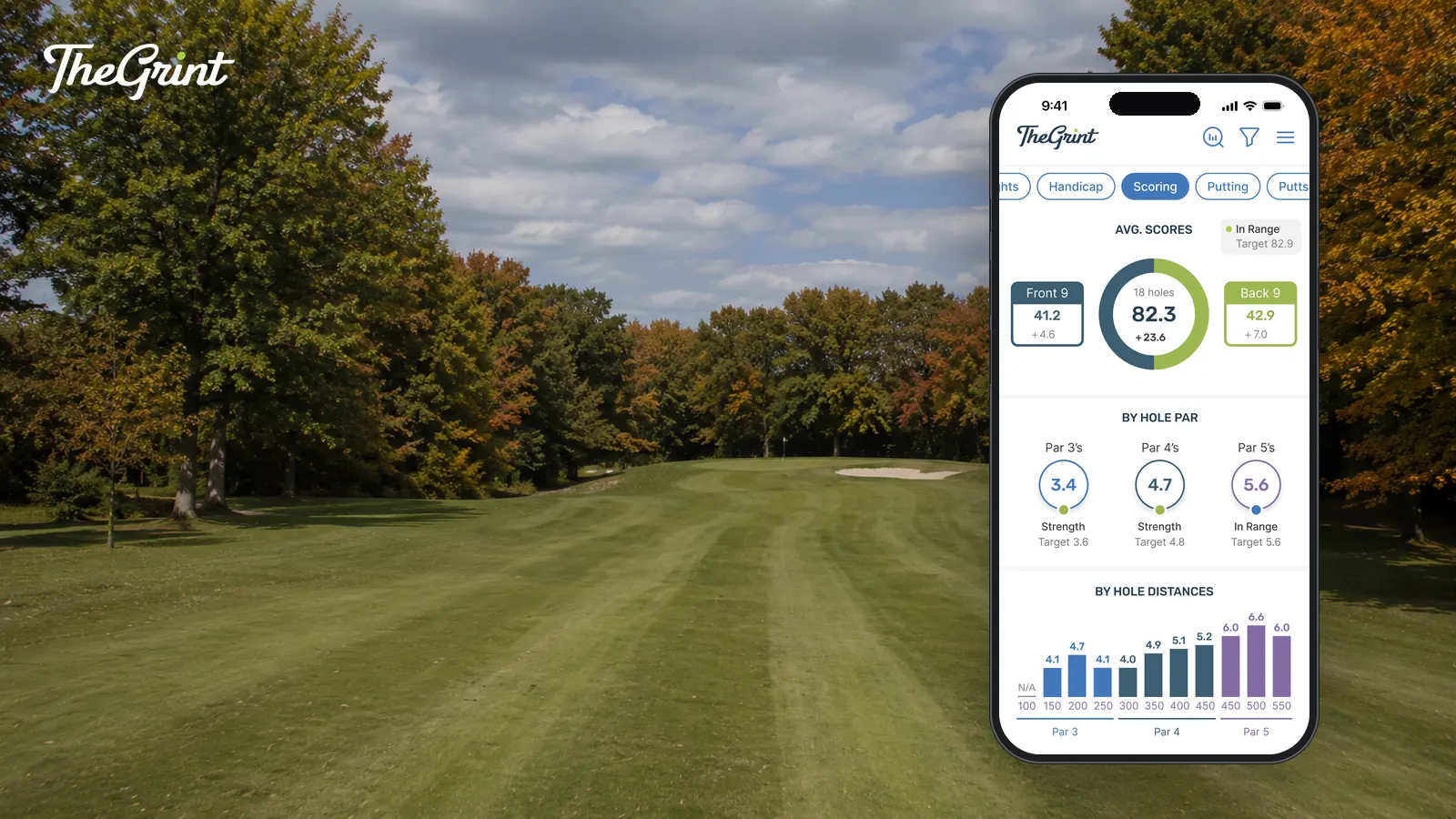
What is GIR in golf? GIR stands for green in regulation: your ball is on the putting surface in par minus two strokes or fewer, meaning one stroke on a par 3, two on a par 4 and three on a par 5. Your GIR percentage is the share of holes where you manage it.
This guide covers the exact definition, how to work out your GIR percentage, what golfers hit at each handicap from scratch to 36 in TheGrint's data, and practical ways to hit more greens.
If you keep score in TheGrint, you do not have to count: the app calculates GIR from the score and putts you enter on each hole.
A green in regulation means your ball is on the putting surface with at least two strokes to spare against par. The LPGA's official stats definition counts a green when "any part of the ball is touching the putting surface" and the strokes taken are two or fewer than par (LPGA: Greens in Regulation Percentage).
The two spare strokes come from how par is built. The USGA® defines par as the score a scratch player would expect on a hole, "allowing for two strokes on the putting green" (USGA: Rules of Handicapping, Definitions). Take those two putts away and what is left is the regulation number of strokes to reach the green.
Two details trip golfers up. A ball resting on the fringe or collar is not on the putting surface, so it is a missed green even if you putt from there. Under the standard definition, reaching the green early also counts: driving a short par 4 or getting home in two on a par 5 is a green in regulation.
GIR percentage is the number of greens you hit in regulation divided by the number of holes you played, multiplied by 100. The PGA TOUR reports it the same way, as greens hit over holes played (PGA TOUR: Greens in Regulation Percentage).
One round is a small sample, so work it out over several. Twenty-five greens across four 18-hole rounds is 25 ÷ 72 = 34.7%, a steadier number to compare with the benchmarks below.

A good GIR percentage depends on your handicap: in TheGrint's 2020 data, scratch golfers hit 59% of greens, 10 handicaps 34%, 20 handicaps 18% and 36 handicaps 6%. The table shows the average at every second handicap level from 0 to 36, with the greens per 18 holes each percentage works out to.
| Handicap | Average GIR % | About this many greens per 18 holes |
|---|---|---|
| 0 | 59% | 10.6 |
| 2 | 54% | 9.7 |
| 4 | 49% | 8.8 |
| 6 | 44% | 7.9 |
| 8 | 39% | 7.0 |
| 10 | 34% | 6.1 |
| 12 | 31% | 5.6 |
| 14 | 27% | 4.9 |
| 16 | 23% | 4.1 |
| 18 | 21% | 3.8 |
| 20 | 18% | 3.2 |
| 22 | 16% | 2.9 |
| 24 | 13% | 2.3 |
| 26 | 12% | 2.2 |
| 28 | 10% | 1.8 |
| 30 | 9% | 1.6 |
| 32 | 9% | 1.6 |
| 34 | 7% | 1.3 |
| 36 | 6% | 1.1 |
About the data: TheGrint calculated the average GIR percentage at each handicap level from 0 to 36 using hole-by-hole scores logged by Grinters, and published the results in 2020. The greens-per-round column is simple arithmetic (percentage × 18). Treat the figures as a 2020 benchmark rather than a current count.

Chart: TheGrint data, 2020.
To use the table, compare your own GIR percentage with the figure for your handicap. Above it, approach play is a relative strength; below it, approach play is where your next strokes are most likely to come from.
Not sure how your handicap compares? See the average golf handicap, or read what a golf handicap measures.
You hit more greens by aiming at bigger targets, clubbing by your real distances, playing tees that suit your length and practicing the approach shots your course asks for.
Then measure the change: compare your GIR percentage across your most recent rounds with the rounds before you made it.
TheGrint calculates GIR automatically from the score and putts you enter on each hole, so there is no separate GIR input. The rule the app applies is SCORE − PUTTS = PAR − 2: when that is true, the hole is marked as a green in regulation. Because the app looks for an exact match, a green reached early, such as a driven par 4 or a par 5 reached in two, is not marked as a green in regulation in your TheGrint stats.
The calculation assumes every putt you enter was taken on the putting green, so count a putt from the fringe as a stroke, not a putt. Scores are golfer-entered; TheGrint does not detect shots or putts automatically. All phone score tracking, Basic and Advanced, is Free; enter your putts on each hole so TheGrint can calculate GIR.
The Greens in Regulation stats then show:
Free members see the high-level numbers; the detailed stat breakdowns are part of a Pro Membership on TheGrint. Pro also includes Insights, which benchmarks GIR alongside seven other stat categories against golfers at your level.
Two related stats help explain a low GIR. Approach Accuracy uses your par-3 tee shots to show whether you tend to miss left, right, short or long, and the putting stats separate your putts after a green in regulation from your putts after a missed green.
No. A green in regulation needs part of the ball touching the putting surface, and the fringe or collar is not part of it. If your approach stops on the fringe, the hole is a missed green even when you putt from there. In TheGrint, count that fringe putt as a stroke rather than a putt so your GIR stays accurate.
Yes, under the standard definition. The regulation number is a maximum, not an exact count, so reaching the green in fewer strokes than par minus two still counts. Driving a short par 4 or reaching a par 5 in two is a green in regulation, and it leaves you putting for birdie or eagle. TheGrint's automatic GIR calculation counts only exact matches (score minus putts equals par minus 2), so those early greens are not marked as greens in regulation in your app stats.
It depends on your handicap. In TheGrint's 2020 data, a 10 handicap averaged 34% of greens, about six per 18 holes, and a 20 handicap averaged 18%, about three. Scratch golfers averaged 59%. Beat the figure for your handicap and approach play is a strength; fall short and it is the area to work on.
GIR counts greens reached in regulation on every hole, including par 3s. FIR, or fairways in regulation, counts tee shots that finish in the fairway on par 4s and par 5s only, since a par-3 tee shot is aimed at the green. The two are linked, because approaches from the fairway are easier to land on the green.
No. A Handicap Index® is built from Score Differential™ values, which compare your adjusted gross score with the Course Rating™ and reflect the Slope Rating™ and playing conditions. Stats such as GIR, fairways and putts are not part of that calculation, although hitting more greens usually lowers your scores and, over time, your handicap.
Enter your score and putts on each hole and TheGrint works out your greens in regulation for you, then keeps your GIR percentage round after round. TheGrint is free on iPhone and Android. Get started with TheGrint.
Handicap Index®, Score Differential™, Course Rating™ and Slope Rating™ are trademarks owned or licensed by the United States Golf Association® (USGA®) and/or The R&A. All rights reserved.


