



TheGrint HQ

11 minutes
Updated
November 9, 2026
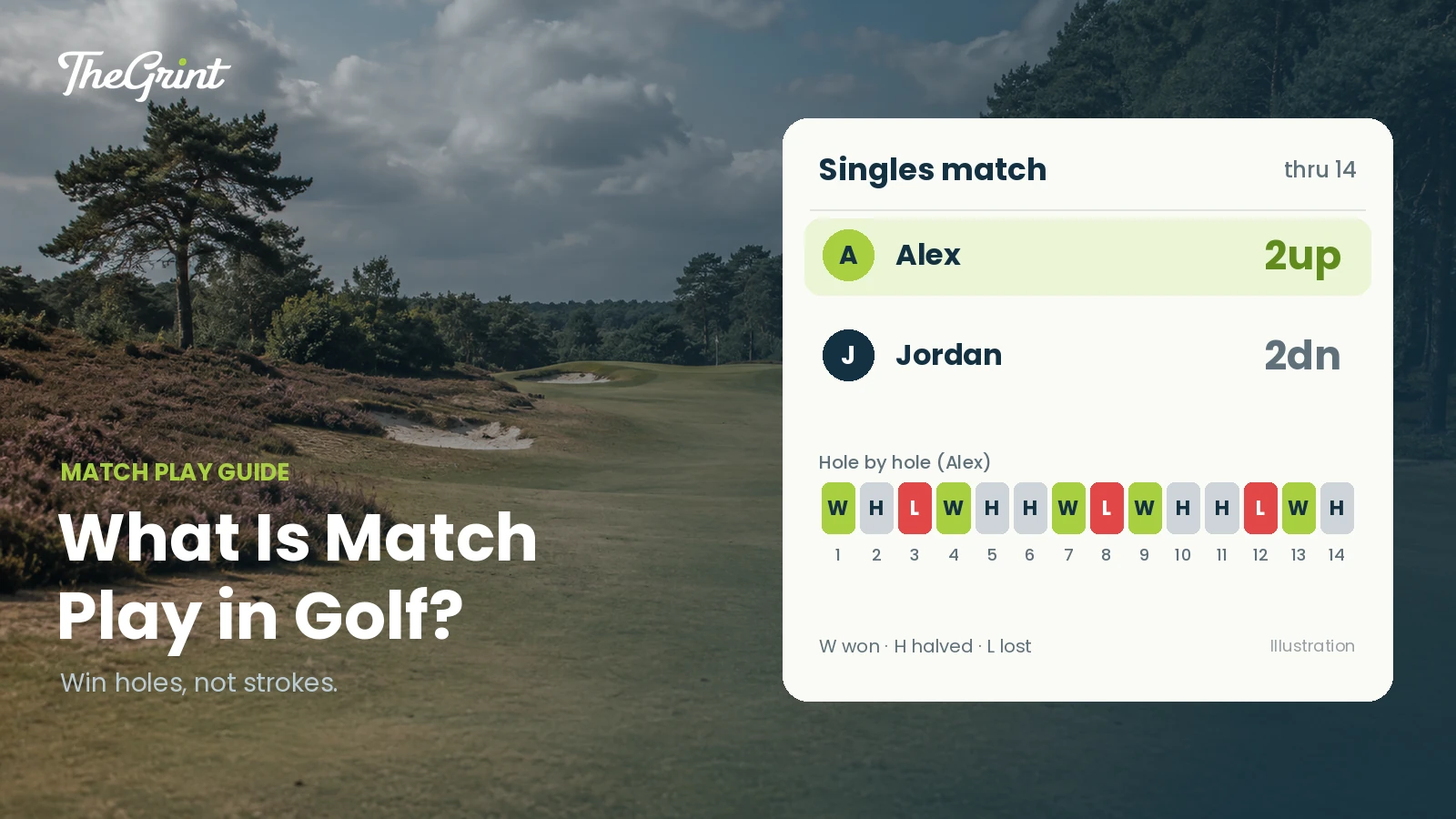
Match play is a form of golf in which you play an opponent hole by hole instead of adding up your total score. The lower score wins each hole, a tie halves it, and the match ends when one side leads by more holes than are left. In a handicap match, the higher handicap receives the difference in strokes.
This guide explains how match play works under the Rules of Golf: how holes are won, what scores like 2 up and 3 and 2 mean, how concessions work, what happens after a tied match, and how handicap strokes are given, with a worked example.
If you play matches with the same group every week, TheGrint keeps the score for you, hole by hole, with net strokes applied.
Match play is golf scored by holes won, lost or tied against an opponent, not by total strokes. The Rules of Golf describe it this way: "a player and an opponent compete against each other based on holes won, lost or tied" (R&A, Rules of Golf, Rule 3).
Stroke play, the other form of play, adds up every stroke over the round and the lowest total wins. Most Rules apply to both forms, but match play has a few of its own, mostly about concessions and telling your opponent how many strokes you've taken.
You win a hole in match play by finishing it in fewer strokes than your opponent, counting penalty strokes. Rule 3.2a lists three ways to win a hole (Rule 3):
A hole is tied, which golfers call "halved", when both players take the same number of strokes. Players can also agree to treat a hole as halved, but only after at least one of them has made a stroke to start it.

Match play is scored by how many holes one player leads by, not by strokes. If you have won two more holes than your opponent, you are "2 up" and your opponent is "2 down". When the players have won the same number of holes, the match is "all square". The players are expected to know the match score (Rule 3.2d).
A match ends as soon as one player leads by more holes than remain. Rule 3.2a says a player wins the match when they lead "by more holes than remain to be played", or when the opponent concedes or is disqualified. That's why many matches finish before the 18th green.
| Match score | What it means | Result |
|---|---|---|
| All square | Both players have won the same number of holes | Match is level |
| 2 up | You have won 2 more holes than your opponent | Match goes on if 2 or more holes are left |
| Dormie 3 | You are 3 up with 3 holes left | You can't lose in regulation; your opponent must win every hole to tie |
| 3 and 2 | You were 3 up with 2 holes left | Match over after 16 holes |
| 1 up | You led by 1 after the 18th hole | Match over after 18 holes |
| Won on the 19th | The match was tied after 18 and you won the first extra hole | Match over after 19 holes |
3 and 2 means the winner was 3 holes ahead with only 2 holes left, so the match ended on the 16th green. The first number is the winning margin and the second is the number of holes that were not played. A 1-up win means the match went the full 18 holes.
A match that is tied after the final hole is extended one hole at a time until there is a winner. Under Rule 3.2a(4), the extra holes are a continuation of the same round, played in the same order as the round unless the Committee sets a different order (Rule 3).
In match play you can concede your opponent's next stroke, a hole or the whole match, and a concession is final once it's clearly made. Rule 3.2b says a concession "cannot be declined or withdrawn", and it can be made out loud or by a clear action such as a gesture (Rule 3).
Match play also lets your opponent cancel a stroke you play out of turn. There's no penalty, but they must cancel it promptly, and you replay from the same spot when it is your turn (Rule 6.4a).
In a handicap match, the player with the lower handicap plays off zero and the other player receives the difference between the two. The USGA® recommends a 100% handicap allowance for individual match play and 90% for Four-Ball match play, and says that after allowances "the player with the lowest Playing Handicap™ plays off zero strokes" (USGA, Rules of Handicapping, Appendix C).
Here is how to work out the strokes for a singles match:
Worked example: an example in Appendix C of the USGA Rules of Handicapping has player A with a Course Handicap of 10 and player B with 18. In singles match play, A plays off zero and B receives 18 − 10 = 8 strokes, one on each hole with stroke index 1 to 8. A plus-handicap player is handled the same way: the lower number still plays off zero.
| Hole | Stroke index | Gross scores | B gets a stroke? | Result |
|---|---|---|---|---|
| 5th | 3 | A 4, B 5 | Yes: B nets 4 | Halved |
| 6th | 11 | A 4, B 5 | No | A wins the hole |
| 7th | 1 | A 5, B 5 | Yes: B nets 4 | B wins the hole |
| 8th | 15 | A 3, B 3 | No | Halved |
For team formats, the allowances change. Our guide to golf handicap allowances covers Four-Ball, Foursomes and scrambles, and how to calculate a golf handicap explains the Course Handicap formula. Players should tell each other their handicaps before the match. Under Rule 3.2c, declaring a handicap that is too high, if it changes the strokes given or received and isn't corrected in time, means disqualification.
Match play counts holes won against one opponent; stroke play counts every stroke against the whole field. The table shows how that changes the way you play.
| Match play | Stroke play | |
|---|---|---|
| What counts | Holes won, lost or halved | Total strokes for the round |
| Who you play against | One opponent or one side | Every player in the field |
| A blow-up hole | Costs one hole | Adds every stroke to your total |
| Conceded putts | Allowed | Not allowed: you must hole out (Rule 3.3c) |
| When it ends | When a lead is bigger than the holes left | After the final hole |
| Handicap allowance (USGA recommendation) | 100% singles, lower handicap plays off zero | 95% individual stroke play |
Because one bad hole only costs a hole, and you watch your opponent play, match play changes decisions: if they're already in the water, you can take the safe line.
Yes, individual and Four-Ball match play are authorized formats under the USGA Rules of Handicapping, in organized competitions and in general play, over 9 or 18 holes (USGA, Rule 2.1a). Conceded putts and holes you pick up on still need a score for handicap purposes.
The most common match play formats are singles, Four-Ball and Foursomes, and many friendly games are match play under another name.
On TheGrint you can play a match as a game inside your round or as a team match in Teams Cup, and the app keeps the score and the net strokes for you.
Running more than one game in the same round, such as a match and a skins game, takes Multi-Games, which is part of a Pro Membership on TheGrint. For more advanced features, try TheGrint Pro free for 7 days. See every game on the games page.
Dormie means a player in match play is ahead by exactly as many holes as are left, such as 3 up with 3 to play. The leading player can no longer lose the match over the scheduled holes. The trailing player has to win every remaining hole just to tie the match and force extra holes.
No, not always. In match play your opponent can concede your next stroke, so a short putt that is conceded counts in your score and you can pick up your ball. The requirement to hole out on every hole is a stroke play rule (Rule 3.3c). In match play you keep playing a hole until it is completed or conceded.
On the first hole, the honor goes by the order of the draw or, with no draw, by agreement or a random method such as tossing a coin. After that, the player who wins a hole tees off first on the next one. If a hole is halved, the player who had the honor on that hole keeps it (Rule 6.4a).
Yes. Four golfers can play match play as two sides of two, either in Four-Ball, where each partner plays their own ball and the better score counts, or in Foursomes, where partners alternate shots with one ball. In TheGrint's games, War mode has each player compete against every other player individually, so everyone in the group plays against everyone else.
In singles match play the USGA recommends a 100% handicap allowance, so the full difference between the two players' Course Handicap numbers is used. You don't play off your whole Course Handicap, though. The lower handicap plays off zero and the higher handicap receives only the difference, given on the holes with the lowest stroke index numbers.
Set up your match before you tee off and TheGrint applies the strokes, scores every hole and keeps the points while you play. Phone scoring and GPS are free, always. Get started with TheGrint.
Handicap Index®, Course Handicap™, Playing Handicap™, Course Rating™, Slope Rating™ and related marks are owned or licensed by the United States Golf Association® (USGA®) and/or The R&A. All rights reserved.


