



TheGrint HQ

8 minutes
Updated
November 3, 2026
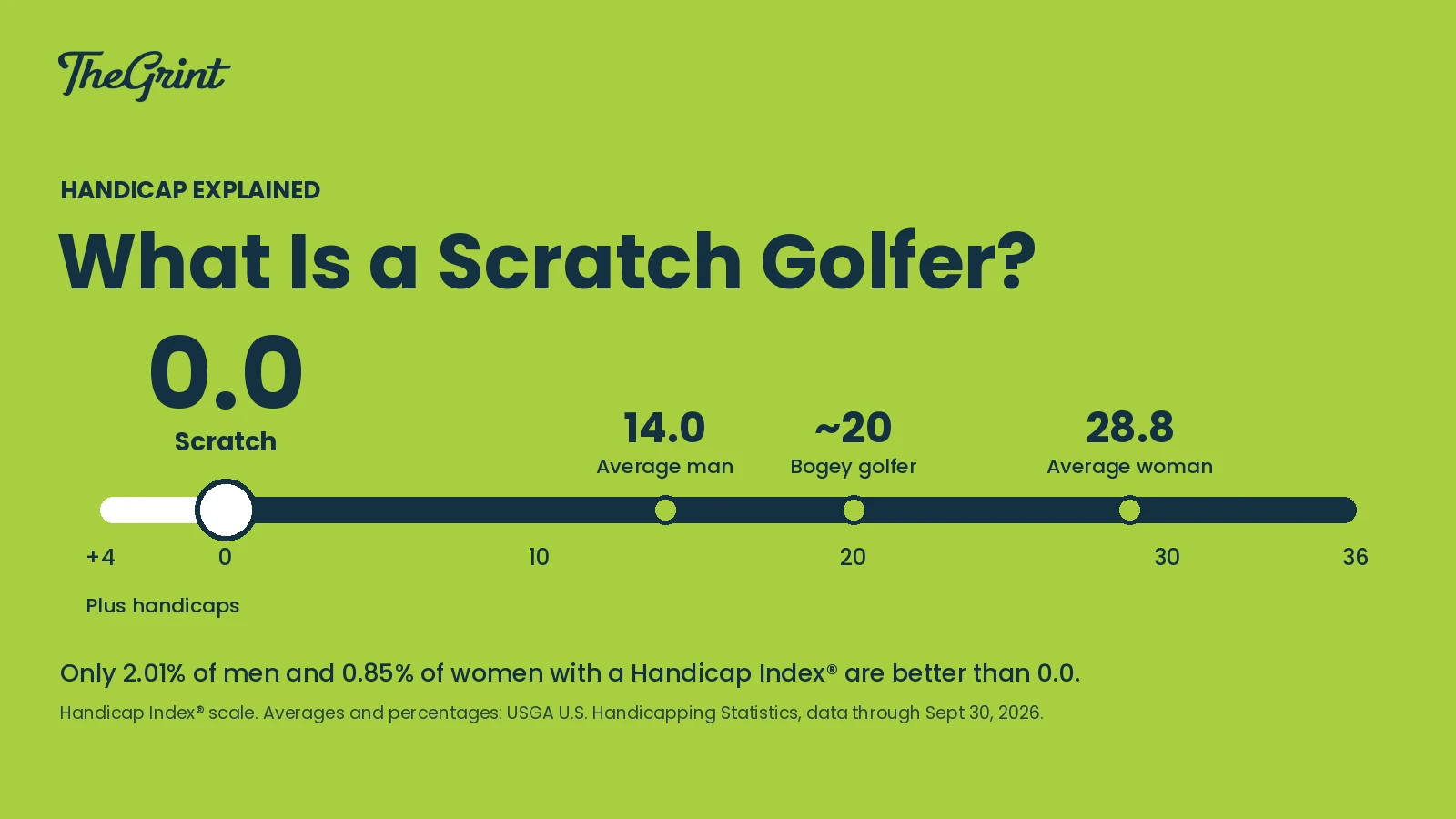
A scratch golfer is a player with a Handicap Index® of 0.0. On good days, a scratch golfer scores about the Course Rating™ of the tees they play, the score the handicap system expects from a scratch player. A golfer whose Handicap Index is better than 0.0 has a plus handicap, written with a plus sign, such as +2.0.
This guide explains what scratch means under the World Handicap System™, why a scratch golfer doesn't always shoot par, how rare scratch and plus handicaps are, and how scratch and plus golfers receive or give back strokes, with worked examples.
Whatever your number is today, TheGrint tracks your scores, your handicap and the stats behind it, from your first round to your best.
A scratch golfer is a golfer whose Handicap Index is 0.0. That is the definition of a scratch player in the USGA® Rules of Handicapping (USGA: Definitions).
So "scratch" isn't a nickname for a very good golfer. It is the exact point the whole rating system is measured from.
A scratch golfer doesn't necessarily shoot par: their good rounds land near the Course Rating, which can be higher or lower than par. On a demanding set of tees rated 74.1 with a par of 72, a scratch golfer's good round is about 74. On short tees rated 70.4, it is about 70.
That is why a scratch golfer can receive strokes on one course and give them back on another. Your Course Handicap™ is worked out with the formula in Rule 6.1a of the Rules of Handicapping (USGA: Rule 6.1a):
Course Handicap = Handicap Index × (Slope Rating ÷ 113) + (Course Rating − par)
The table below uses made-up tees to show how it plays out for a scratch golfer and for a golfer with a +2.0 Handicap Index. In the formula, a plus Handicap Index counts as a negative number.
| Golfer | Tees (Course Rating / Slope Rating / par) | Calculation | Course Handicap |
|---|---|---|---|
| Scratch (0.0) | 74.1 / 135 / 72 | 0.0 × (135 ÷ 113) + (74.1 − 72) = 2.1 | 2 (receives 2 strokes) |
| Scratch (0.0) | 70.4 / 125 / 72 | 0.0 × (125 ÷ 113) + (70.4 − 72) = −1.6 | +2 (gives back 2 strokes) |
| Plus (+2.0) | 74.1 / 135 / 72 | −2.0 × (135 ÷ 113) + (74.1 − 72) = −0.29 | 0 (plays level) |
| Plus (+2.0) | 70.4 / 125 / 72 | −2.0 × (125 ÷ 113) + (70.4 − 72) = −3.81 | +4 (gives back 4 strokes) |
Rule 6.1a rounds the result to the nearest whole number as the final step. For a deeper look at the two ratings, see what slope means in golf.
Scratch and plus golfers are rare: only 2.01% of men and 0.85% of women with a Handicap Index are better than 0.0, according to the U.S. Handicapping Statistics page from the USGA (data through September 30, 2026).
For the full distribution and what counts as a good handicap at every level, see the average golf handicap.

A plus handicap is a Handicap Index better than scratch. Rule 5.2c says that when a Handicap Index "calculates as a negative figure, this represents a plus Handicap Index" (USGA: Rule 5.2c).
A golfer with a Course Handicap of +4 who shoots a gross 70 has a net score of 74.
A scratch or plus golfer gets strokes only when their Course Handicap is above zero, and gives strokes back when it is below zero. The Course Handicap, not the Handicap Index, decides it, which is why the same golfer can do both in the same season.
Net double bogey works the same way. Rule 3.1b caps each hole at par plus 2 plus any strokes you receive, "or minus any handicap stroke(s) that a plus handicap player gives back on that hole" (USGA: Rule 3.1b). A plus golfer who gives back a stroke on a par 4 has a maximum hole score of 5, not 6.
In competitions, a handicap allowance moves everyone's Playing Handicap™ toward zero, plus golfers included. For example, at an 80% allowance a +5 Course Handicap becomes a +4 Playing Handicap (World Handicap System FAQs).
A 0.0 Handicap Index says your best scores match the Course Rating, not that every round does. Under Rule 5.2b, a Handicap Index is the average of "the lowest 8 of the most recent 20 Score Differentials" (USGA: Rule 5.2b).
So a 0.0 Handicap Index means the lowest 8 of a golfer's last 20 Score Differential™ values average 0.0, the level of a round played to the Course Rating, and the other 12 are no better. A scratch golfer who plays a typical round a few strokes over the Course Rating is playing to their handicap, not below it.
The arithmetic, with a full worked example, is in how to calculate a golf handicap, and the basics are in what a golf handicap is.
TheGrint keeps your scores, your handicap and the stats behind both in one place, so you can see how far you are from scratch and where the strokes are. TheGrint is free, always, and is trusted by millions of golfers.
Yes, a plus handicap is better than scratch: it is a Handicap Index better than 0.0, so a +2.0 golfer has shown they can play about two strokes better than a scratch golfer. Plus-handicap golfers usually give strokes back to the course, which means strokes are added to their gross score to get their net score.
Yes, a scratch golfer can get handicap strokes. They receive strokes whenever their Course Handicap is above zero, which happens on tees where the Course Rating is at least half a stroke higher than par. With a Handicap Index of 0.0 on tees rated 74.1 with a par of 72, the Course Handicap is 2, so the golfer receives 2 strokes.
Put a plus sign in front of it, such as +1.4. Every other Handicap Index has no prefix. A handicap written with a minus sign, such as −1.4, is usually a mistake and should be checked. TheGrint shows plus handicaps with the plus sign.
A scratch golfer has a Handicap Index of 0.0. A bogey golfer has a Handicap Index of about 20.0 for men and about 24.0 for women. Course raters assess every set of tees for both golfers: the Course Rating describes the course for the scratch golfer, and the Slope Rating shows its relative difficulty for everyone else.
Not always. Being a scratch golfer means a Handicap Index of 0.0, which travels with you from course to course. A Course Handicap of 0 only applies to one set of tees. A +2.0 golfer can have a Course Handicap of 0 on tough tees, and a scratch golfer can have a Course Handicap of 2.
Post each round hole by hole and TheGrint works out your estimated handicap, applies net double bogey and shows what separates you from scratch. When you want the official number, buy the USGA Handicap ID in the app (U.S.) or link your GHIN number. For more advanced features, try TheGrint Pro free for 7 days. Get started with TheGrint.
World Handicap System™, Handicap Index®, Course Handicap™, Playing Handicap™, Score Differential™, Course Rating™, Slope Rating™ and related marks are owned or licensed by the United States Golf Association® (USGA®) and/or The R&A. GHIN® is a registered trademark of the USGA. All rights reserved.


