
TheGrint HQ

9 minutes
Updated
October 20, 2026
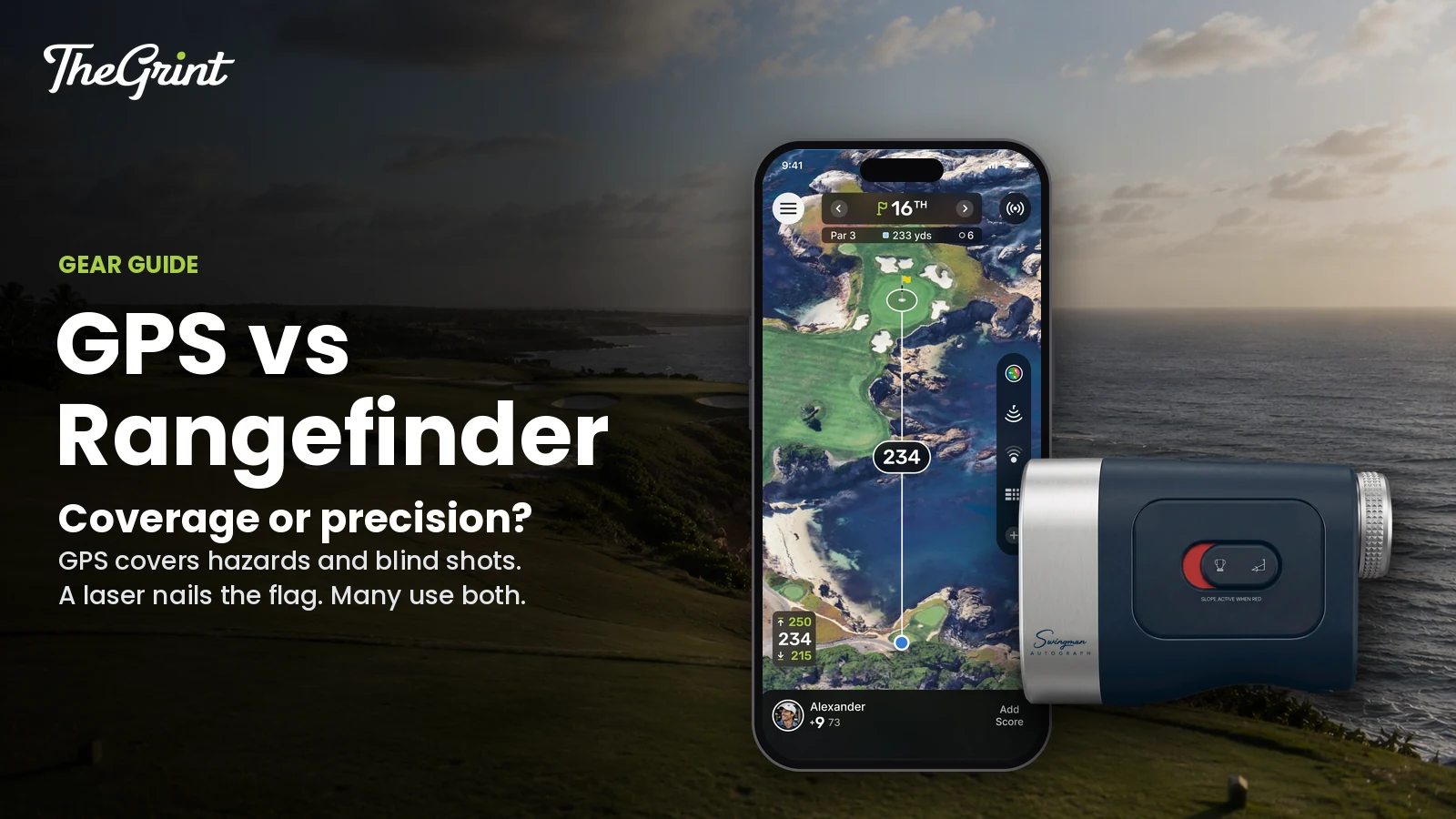
Golf GPS vs rangefinder comes down to coverage versus precision. A golf GPS app or watch gives front, center and back distances to the green, plus hazard and layup numbers, from anywhere on the hole without line of sight. A laser rangefinder gives a precise line-of-sight number to the flag or any target you can see. Many golfers use both.
This guide compares the two side by side, covers what the Rules of Golf allow, explains slope, and helps you decide which one fits your game. If you want to start with GPS, TheGrint includes free GPS maps and distances for 40,000+ courses on your phone, plus free GPS distances on supported watches.
A golf GPS uses your location and a pre-mapped course to calculate distances, while a laser rangefinder measures the distance to whatever you point it at. One works from a map; the other works from what you can see.
A GPS app or watch knows where the green, bunkers and water are because the course has been mapped. Stand anywhere on the hole and it can tell you how far you are from the front, center and back of the green, or how far it is to carry a bunker you can't see from the tee.
A laser rangefinder fires a beam at a target and reports the line-of-sight distance to it. Point it at the flagstick and you get the number to the hole as it is cut today, not to the middle of the green. If you can't see the target, the laser can't measure it.
A golf GPS is stronger on coverage, hazards and blind shots, and a laser is stronger on the exact number to a visible flag. Here is how they compare on the things that matter during a round:
| Golf GPS (app or watch) | Laser rangefinder | |
|---|---|---|
| Accuracy to the pin | Front, center and back of the green; the exact hole location changes daily and isn't in the course map | Precise line-of-sight number to the flagstick |
| Hazards and layup distances | Shown on the map for every mapped hazard, including carry and layup numbers | Only when you can see the hazard and hit a clear target on it |
| Blind shots | Works, because it doesn't need to see the target | Can't measure what you can't see |
| Speed | Numbers are already on screen when you glance down | Quick when the target is visible, but you need to aim and hold steady |
| Cost of ownership | Runs on a phone or watch you may already own; many apps have a free tier | A one-time hardware purchase |
| Battery | Uses your phone's or watch's battery | Has its own battery to keep charged or replace |
| Needs line of sight | No | Yes |
| Works on any course | Any course the app has mapped | Any course, no map needed |
| Slope | Depends on the app; TheGrint's app GPS shows straight distances with no slope adjustment | Some models offer a slope mode that is a hardware feature of the laser |
A golf GPS app is accurate enough for most shots, because most approach decisions are about the green as a whole, not the exact hole location. Knowing the front, center and back numbers tells you what club carries the front edge and what club stays short of the back.
Where GPS gives up ground is the flag itself. A course map shows where the green is, not where the hole is cut today, so a back pin on a deep green can be well past the center number. That gap matters most to golfers who can control their distance closely.
GPS accuracy also depends on your device's signal and on how well the course has been mapped. If a number looks wrong, a quick check against a sprinkler head or yardage marker is a good habit with any GPS.
A laser rangefinder is the better tool when you can see the flag and want the exact number to it. That is most often on approach shots and par 3s, where the difference between a front and back pin can be a full club or more.
Where a laser struggles is everything it can't see: blind tee shots, hazards hidden by a slope, and the far side of a dogleg. That is where a GPS earns its place.
Yes, distance-measuring devices are allowed under the Rules of Golf unless the Committee running the competition adopts a Local Rule that prohibits them. Rule 4.3a(1) lists "Getting information on distance or direction (such as from a distance-measuring device or compass)" as allowed (R&A, Rules of Golf, Rule 4).
The same Rule lists "Measuring elevation changes" as not allowed, along with "Interpreting distance or directional information (such as using a device to get a recommended line of play or club selection based on the location of the player's ball)." A breach of Rule 4.3 carries the general penalty for a first breach and disqualification for a second.
The USGA® championships show how this works in practice. Distance-measuring devices are permitted in its amateur championships "so long as the player uses it to measure distance only," while Model Local Rule G-5 bans them during the championship proper of the U.S. Open, U.S. Women's Open, U.S. Senior Open and U.S. Senior Women's Open (USGA, Are Distance Measuring Devices permitted?).
Before a competition, check the event's terms and Local Rules. If your laser has a slope mode, switch it off before you tee off.
Choose the tool that fixes the decision you get wrong most often: GPS if it's hazards and blind shots, a laser if it's the exact number to the flag, and both if you want every number available.
TheGrint GPS gives you free course maps and distances for 40,000+ courses on your phone and free GPS distances on supported watches, and Swingman rangefinders connect to TheGrint so the laser can also show GPS green distances. Here is what each part does:
Swingman rangefinders connect to TheGrint and use its course data. With a Pro Membership on TheGrint, the rangefinder shows front, center and back green distances and the relative pin location. The laser and slope functions work without Pro.
The Swingman Autograph Rangefinder adds slope-adjusted laser yardages and an external display. That slope reading is a feature of the laser hardware, not of TheGrint's app GPS, so turn it off whenever the Rules or the event's terms require it.
For a tour of the redesigned screens, see the new GPS experience on TheGrint, or go straight to TheGrint GPS features. To see what each tier includes, compare Free and Pro on TheGrint.
For distances to the green and to hazards, a golf GPS app is accurate enough for most golfers. A laser is more precise to the flag, because it measures to the flagstick itself, while GPS measures to the front, center and back of the green. GPS accuracy also depends on your device's signal and how well the course is mapped.
Usually, yes. The Rules of Golf allow distance-measuring devices unless the Committee adopts a Local Rule banning them. The USGA permits them in its amateur championships but bans them during the championship proper of the U.S. Open and three other national opens. Slope or elevation readings are not allowed, so check the event's terms and switch slope off.
Not necessarily. A GPS watch already gives you front, center and back green distances and works on blind shots. A rangefinder adds the exact number to the flag, which matters most if you control your distances closely or often face front and back pins on deep greens. Many golfers start with GPS and add a laser later.
Slope is a rangefinder mode that adjusts the measured distance for the change in elevation between you and the target, so an uphill shot reads longer and a downhill shot shorter. Measuring elevation changes is not allowed during a round under the Rules of Golf, so slope must be off in competition. Casual rounds are up to your group.
No. A golf "rangefinder app" is a GPS app: it calculates distances from your location and a mapped course, so it works without line of sight but measures to the green rather than the flag. A laser rangefinder is a separate device that measures the line-of-sight distance to whatever target you aim it at.
Open TheGrint, tap Play, and your GPS distances are on screen next to your scorecard on your phone, with GPS distances on your watch too. The same app keeps your scores, stats and handicap in one place. TheGrint is free, always. For more advanced features, try TheGrint Pro free for 7 days. Get TheGrint.
USGA® is a registered trademark of the United States Golf Association®. All rights reserved.


