



TheGrint HQ

5 minutes
Updated
November 9, 2026
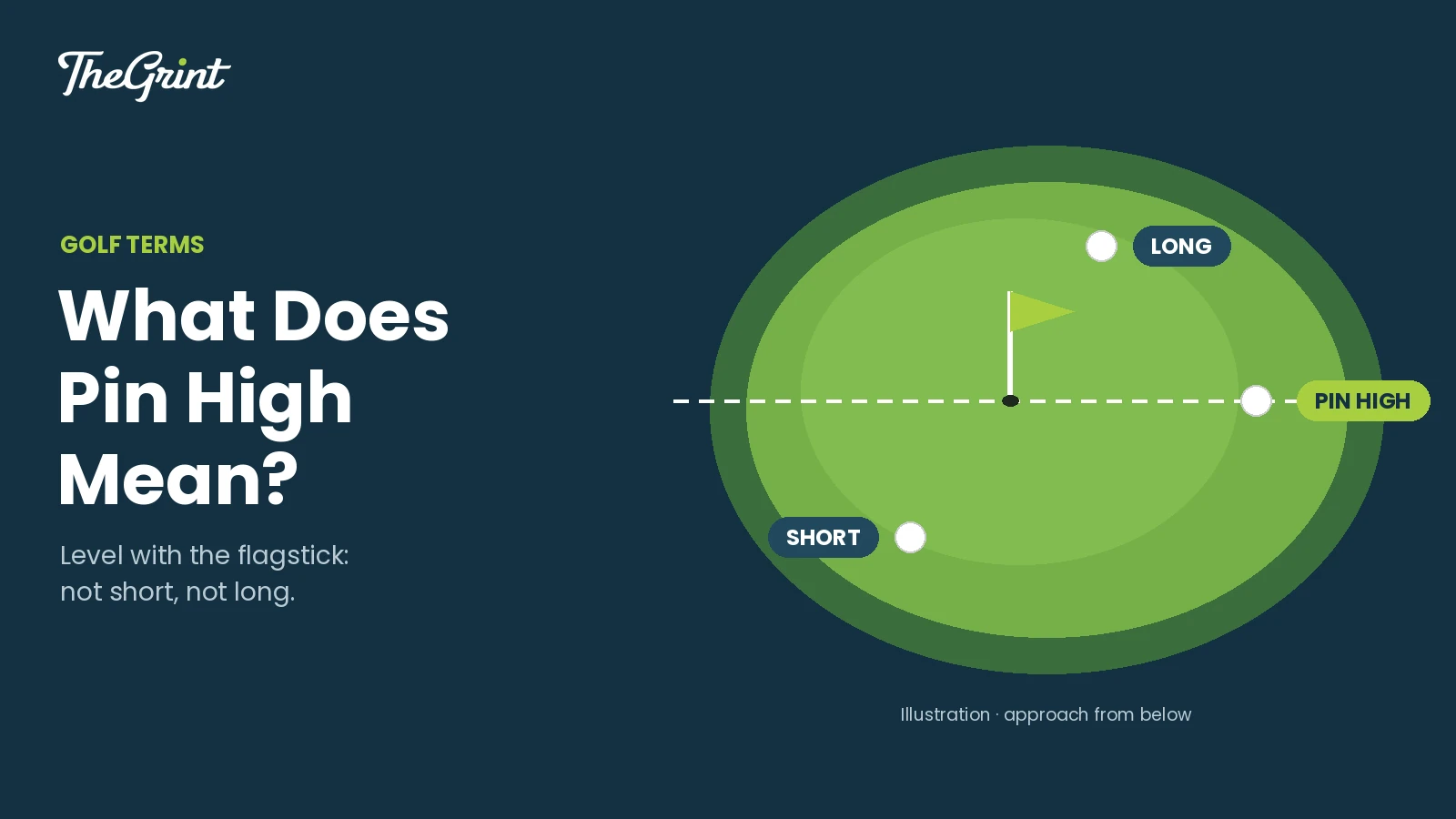
Pin high means your ball finishes level with the flagstick, the same distance from you as the hole, whether it ends up to the left or the right of it. A pin-high shot is neither short nor long. Golfers also call this being "hole high."
This guide explains pin high, how it differs from short and long of the pin, and how to hit more shots that finish there. TheGrint's golf GPS gives you the distances to the green to help.
Pin high is a description of distance: your ball finished the same distance from you as the flagstick. Picture a line running across the green through the hole, from the left edge to the right edge. A ball anywhere on that line is pin high.
That is why a golfer can say "pin high, but 20 feet right." The distance was right and the direction was off. Pin high tells you about your distance control, not about how close you finished.
Yes, hole high and pin high mean the same thing: a ball level with the hole. The two phrases are interchangeable, and you will hear both on the course.
The flagstick is also called the pin, which is why the term uses that word. Whichever phrase your group prefers, the meaning does not change.
Short of the pin means the ball finished closer to you than the flagstick, and long of the pin (or past the pin) means it finished farther away. Together with pin high, these three terms describe every shot by distance. The table shows how they compare.
| Term | Where the ball finishes | What it tells you |
|---|---|---|
| Short of the pin | Closer to you than the flagstick | You did not hit the ball far enough |
| Pin high (hole high) | Level with the flagstick | Your distance was right |
| Long of the pin | Farther from you than the flagstick | You hit the ball too far |
Left and right are separate. A shot can be pin high and left, or short and right. Distance is one question, and direction is another.
Being pin high matters because distance control is what keeps your approach shots close to the hole. When you are pin high, your miss is only to the side, and a miss to the side is usually shorter and easier to deal with than one that leaves a long putt.
You hit more pin-high shots by knowing the distance to the green and choosing a club for that number. Many missed greens come from guessing the yardage instead of knowing it.
TheGrint's golf GPS shows the distances to the front, center and back of the green on 40,000+ courses, and these GPS maps and distances are free. That gives you the numbers for step one above on every hole.
If you own a Swingman rangefinder, TheGrint Pro can show where the pin sits on the green.
Being pin high means your ball has finished level with the flagstick, the same distance from you as the hole. It can be left or right of the pin and still be pin high. The term describes distance only, not how close the ball is to the hole.
There is no difference. Pin high and hole high both mean a ball that ends up level with the hole, neither short of it nor past it. Golfers use the two interchangeably in conversation and on the course, and the meaning does not change.
Not necessarily. A pin-high ball can be 30 feet to the left or right of the flag and still be pin high, because the term only measures whether you got the distance right. Close to the hole means good distance and good direction together.
No. Green in regulation means reaching the green in two strokes fewer than par, such as two shots on a par 4. Pin high describes where a shot finishes compared with the flagstick. A shot can be pin high and miss the green, or hit the green and be short or long.
Look at the shot from the side. If the ball finished level with the flagstick, neither nearer to you nor farther away, it is pin high. Playing partners standing beside the green are usually the best judges, since it is hard to tell from behind the ball.
TheGrint is free, always, with GPS distances to the front, center and back of the green. For more advanced features, try TheGrint Pro free for 7 days. Get started with TheGrint.


