



TheGrint HQ

8 minutes
Updated
November 9, 2026
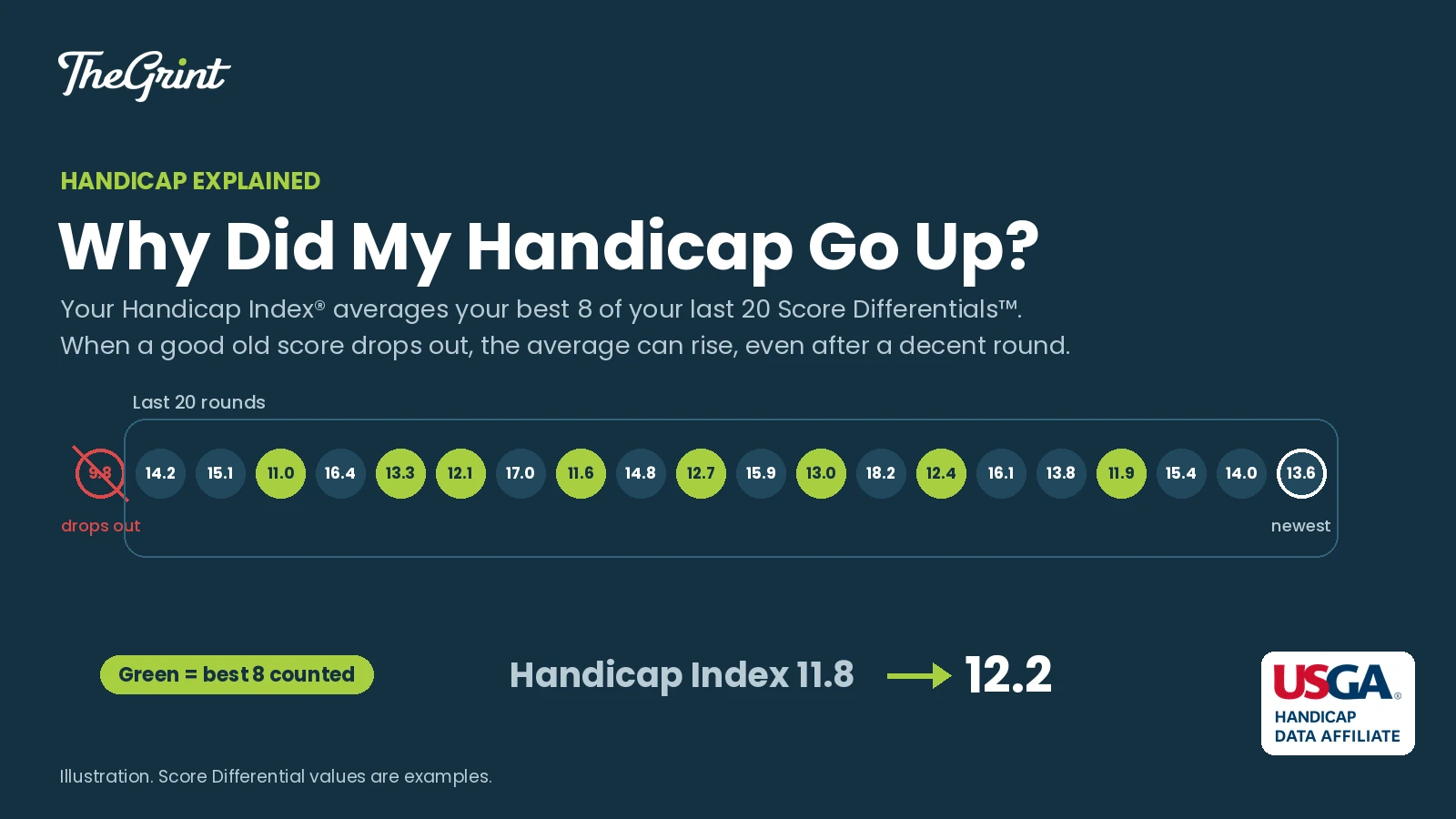
Your Handicap Index® goes up when the average of the best 8 of your most recent 20 Score Differential™ values goes up. That happens when a strong older round drops out of the 20, when new rounds aren't good enough to replace it, or when the playing conditions calculation changes a round's differential. The soft cap and hard cap then limit how far an Index can rise.
This guide shows why an Index can rise even after a round you were happy with, using a worked example, and lists what to check when yours moves. For the full formula, see how your handicap is calculated; for the safeguards in detail, see the soft cap and hard cap explained.
If you have an official Handicap ID linked on TheGrint, your Handicap Index and Low Handicap Index™ sit side by side on the handicap screen, so you can see where you stand against your own recent best.
Your Handicap Index is the average of your lowest 8 Score Differential values from your most recent 20 rounds, rounded to the nearest tenth. Two things change that average every time you post: the new round comes in, and, once you have 20, the oldest round goes out.
Scores are not dropped by date. According to the Rules of Handicapping, a score stays in the calculation for as long as it is among your most recent 20, however old it is. So a career round from last spring can quietly hold your Index down for months, and it leaves once 20 newer scores have been posted.
That is why the effect can feel unfair. If the round leaving the window was one of your best 8, the new round has to beat it, not merely beat your average, or the Index rises.
Take a golfer with 20 rounds on record and a Handicap Index of 11.6. Their 20 Score Differential values average 13.6, so a round at 12.8 is better than they usually play. They post it as round 21. The numbers below are illustrative, not TheGrint member data.
| Round (1 = oldest) | Score Differential | In best 8 before round 21? | In best 8 after round 21? |
|---|---|---|---|
| 1 | 9.0 | Yes | Rolled off |
| 2 | 15.2 | No | No |
| 3 | 13.8 | No | No |
| 4 | 11.1 | Yes | Yes |
| 5 | 16.4 | No | No |
| 6 | 12.7 | Yes | Yes |
| 7 | 14.9 | No | No |
| 8 | 10.3 | Yes | Yes |
| 9 | 13.2 | No | No |
| 10 | 17.0 | No | No |
| 11 | 12.2 | Yes | Yes |
| 12 | 15.8 | No | No |
| 13 | 11.9 | Yes | Yes |
| 14 | 14.1 | No | No |
| 15 | 13.5 | No | No |
| 16 | 16.1 | No | No |
| 17 | 12.4 | Yes | Yes |
| 18 | 14.6 | No | No |
| 19 | 13.1 | Yes | Yes |
| 20 | 15.3 | No | No |
| 21 | 12.8 | Not played yet | Yes |
Round 1, at 9.0, was their best score and had been holding the Index down. It rolls off as round 21 comes in. Round 21 earns a place in the best 8, but the 9.0 it replaces was 3.8 strokes lower.
| Before round 21 | After round 21 | |
|---|---|---|
| Rounds in the window | Rounds 1 to 20 | Rounds 2 to 21 |
| Best 8 Score Differential values added up | 92.7 | 96.5 |
| Divided by 8 | 11.5875 | 12.0625 |
| Handicap Index | 11.6 | 12.1 |
The best 8 added up to 92.7 before and 96.5 after, a difference of 3.8. Spread over 8 values, that is about 0.5, and the Index moves from 11.6 to 12.1. The golfer played better than their average and the Handicap Index still went up, because the round that left was better still.
In this example the new Index is only 0.5 above the Low Handicap Index of 11.6, so neither cap applies.
This is the example above. If your Index rose after a normal round, look at the round that left your window, not just the one you just posted.
Only the best 8 of 20 count, so 12 rounds are ignored at any moment. But when your latest scores are all weaker than the ones that dropped out, the best 8 shifts upward. A run of rounds near your average can raise your Index, because the Index is built from the better end of your scoring, not the middle.
The playing conditions calculation (PCC) is a daily procedure that compares the scores submitted on a course with what the statistics expected. It can apply an adjustment of -1.0, 0.0, +1.0, +2.0 or +3.0 in the calculation of Score Differential values for every player that day. It equals zero if fewer than eight acceptable scores are submitted, and only scores from players with a Handicap Index of 36.0 or below are used to work it out.
The result is that two identical gross scores on different days can produce different differentials. For what a +3 means in practice, see how your handicap is calculated.
Before you reach 20 acceptable scores, your Handicap Index is calculated from the lowest Score Differential values in your scoring record, with the number used set by a table in the Rules of Handicapping. With a short record, each new score matters more than it will later, so early swings are larger. A Low Handicap Index is not established until you have 20 acceptable scores.
The caps do not cause an increase. They limit it. Your Low Handicap Index is the lowest Handicap Index you had in the 365 days before your most recent round, and the caps compare your newly calculated Index with it.
| Case | Low Handicap Index | Calculated Index | What happens | New Handicap Index |
|---|---|---|---|---|
| A modest rise | 11.6 | 13.9 | 2.3 above Low, no cap | 13.9 |
| Soft cap | 10.0 | 14.0 | 3.0 plus half of 1.0 | 13.5 |
In the second row, a calculated 14.0 is 4.0 above a Low of 10.0. The first 3.0 counts in full and half of the last 1.0 is added, so the Index is 13.5 rather than 14.0. Your golf club can override the caps in circumstances such as injury or illness.
If you want the full walk-through, including the hard cap and exceptional score reductions, read the soft cap and hard cap guide. New to the basics? Start with what a golf handicap is.
None of these is a penalty. The Index is designed to reflect your demonstrated ability, and it moves when the best end of your recent scoring moves.
With a linked or official Handicap ID, the number is your official Handicap Index, shown next to your Low Handicap Index, and a round that triggered an exceptional score reduction is marked with an E in your scorecards list. Without one, Free members see an estimated handicap range and Pro members a whole-number estimate.
A good round only lowers your Handicap Index if it is one of your best 8 Score Differential values and it replaces a worse one. If the round that dropped out of your most recent 20 was better than the new round, the average of your best 8 goes up even though you played well.
Each acceptable score adds a new Score Differential and, once you have 20, pushes the oldest one out. The Index is then the average of the lowest 8 of the most recent 20 values, rounded to the nearest tenth, so it moves only when the best 8 change.
Scores are not removed by date. A score stays in the calculation for as long as it is one of your most recent 20, however old it is, and leaves once 20 newer scores have been posted.
Not while a Low Handicap Index applies. The hard cap holds your Index to no more than 5.0 strokes above your Low Handicap Index, after the soft cap is applied. There is no limit on how fast it can go down.
The playing conditions calculation (PCC) is a daily statistical check of how scores on a course compared with what was expected. It can apply an adjustment of -1.0, 0.0, +1.0, +2.0 or +3.0 when Score Differential values are calculated for that day, so a round's differential can differ from what its raw score alone suggests.
Check whether a very good older round has just left your most recent 20, and whether your recent rounds are close to your average rather than your best. Your best 8 sets the Index, so a few ordinary rounds can move it even when the golf feels good.
Post your rounds in TheGrint, with free GPS distances and hole-by-hole scoring, and, with a linked Handicap ID, see your Handicap Index next to your Low Handicap Index. Get TheGrint.
Handicap Index®, Low Handicap Index™ and Score Differential™ are owned or licensed by the United States Golf Association® (USGA®) and/or The R&A. GHIN® is a registered trademark of the USGA. All rights reserved.


