



TheGrint HQ

6 minutes
Updated
November 3, 2026
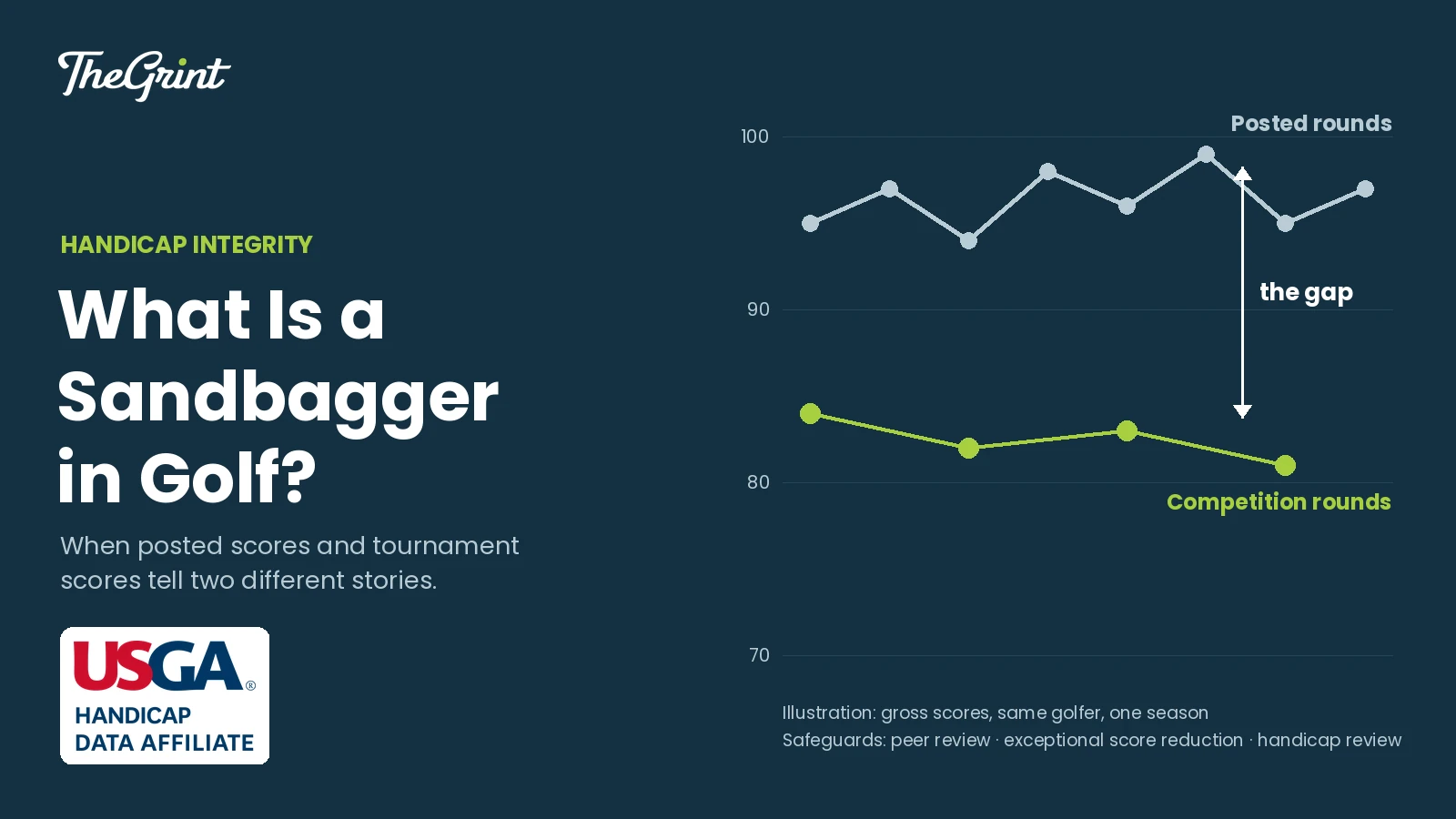
A sandbagger in golf is a player who keeps their handicap higher than their real ability, usually by not posting good scores or by inflating bad ones, to get extra strokes in net competitions. Under the World Handicap System™, peer review, exceptional score reductions and handicap reviews exist to catch it.
This guide explains how sandbagging works, why it breaks the Rules of Handicapping, the safeguards that catch it, what to do if you suspect someone in your group and how score transparency on TheGrint makes it harder to hide.
On TheGrint, playing partners can attest your scores and edited scores show up in your friends' feeds, so you can keep an honest handicap on TheGrint that everyone in your group can trust.
Sandbagging means deliberately carrying a higher handicap than your real ability so you receive more strokes than you should. The extra strokes only pay off in net games and tournaments, which is why sandbagging tends to show up when there is a prize at stake.
The opposite problem, a vanity handicap, is lower than the player's real ability because only good rounds get posted. Both make net competition unfair. For how a handicap should be built, see what a golf handicap is.
Yes. Under the USGA® Rules of Handicapping, every player is expected to act with integrity, to "attempt to make the best score possible at each hole" and to submit all acceptable scores. Sandbagging breaks all three (USGA: Rule 1.3).
The rules also list "preventing a low score from causing a Handicap Index to decrease" as a reason that is not a valid excuse for failing to submit a score (USGA: Rule 7.1b).
The handicap system catches sandbaggers with five safeguards: peer review by the players you golf with, automatic reductions after exceptional scores, handicap reviews by the club's Handicap Committee, penalty scores for rounds that were not posted and, in the worst cases, withdrawal of the Handicap Index.
| Safeguard | What it does | Who acts |
|---|---|---|
| Peer review | The process by which a score or Handicap Index can be confirmed or challenged (USGA definitions) | Your playing partners |
| Exceptional score reduction | A Score Differential™ 7.0 to 9.9 strokes better than your Handicap Index lowers it by 1.0; 10.0 or more lowers it by 2.0 | Applied automatically |
| Handicap review | The Committee can adjust a Handicap Index (by at least 1 stroke) or freeze it, after informing the player and letting them respond | Handicap Committee |
| Penalty score | A score is posted for a round the player failed to submit without a valid reason | Handicap Committee |
| Withdrawal | The Handicap Index is withdrawn from a player who deliberately or repeatedly fails to meet their responsibilities | Committee or association |
An exceptional score reduction can be triggered in a single round, and a reduction of 2.0 or several reductions also flag the player for the Committee's consideration (USGA: Rule 5.9). For how it interacts with the caps, see soft cap, hard cap and exceptional scores.

Before adjusting a Handicap Index, the Committee weighs the evidence. One of the factors in Rule 7.1a is whether a player performs significantly differently in one format compared with another, for example in organized competitions versus general play. A review at least once a year for every member is strongly recommended (USGA: Rule 7.1a).
If you suspect a sandbagger, raise it with the Handicap Committee rather than with the player in the parking lot. A handicap review can be requested by the player or by another player at any time, and the player must be informed and allowed to respond before any change.
For casual games with friends, you can also choose a format where extra strokes matter less, such as a scramble or a points game. See golf games for different handicaps.
TheGrint makes handicap-sensitive changes visible, which supports the same idea as peer review. Your playing partners can vouch for a score, and changes to old scores show up in your friends' feeds.
An estimated handicap on TheGrint is not an official Handicap Index. In the United States, TheGrint provides official Handicap IDs through the USGA and your Allied Golf Association. See how attesting scores works and why edited and deleted scores are marked.
Yes. Under the Rules of Handicapping, players are expected to act with integrity, try to make the best score possible at each hole and submit all acceptable scores. Keeping a handicap artificially high to win net events breaks those responsibilities, and a Handicap Committee can adjust, freeze or withdraw the player's Handicap Index.
The opposite of a sandbagger is a vanity handicap: a golfer whose handicap is lower than their real ability, usually because they post only their good rounds. It does not win them extra strokes, but it is just as inaccurate, and the same rule applies: post every acceptable score so the handicap reflects how you really play.
Talk to the Handicap Committee at the player's home club, which conducts handicap reviews; a competition committee can pass the concern on. Under the Rules of Handicapping, a handicap review can be requested by the player or by another player at any time. Bring specifics, such as competition scores far better than the player's posted rounds.
Yes. When a round's Score Differential is 7.0 to 9.9 strokes better than the player's Handicap Index, the Handicap Index is reduced by 1.0, and by 2.0 when the gap is 10.0 strokes or more. The reduction is applied automatically and fades as new scores replace older ones.
Yes. When you edit or delete scoring data that affects your posted score, TheGrint marks it EDITED or DELETED and posts it to the top of your friends' Activity Feeds, even if the round is old. Changing details unrelated to the handicap formula, such as putts or tee accuracy, does not trigger the mark.
Post every round hole by hole, ask your playing partners to attest and let your handicap show how you really play. Link your GHIN number or buy a Handicap ID inside the app in the U.S. Get started with TheGrint.
World Handicap System™, Handicap Index®, Score Differential™ and related marks are owned or licensed by the United States Golf Association® (USGA®) and/or The R&A. GHIN® is a registered trademark of the USGA. All rights reserved.


