
TheGrint HQ

10 minutes
Updated
October 20, 2026
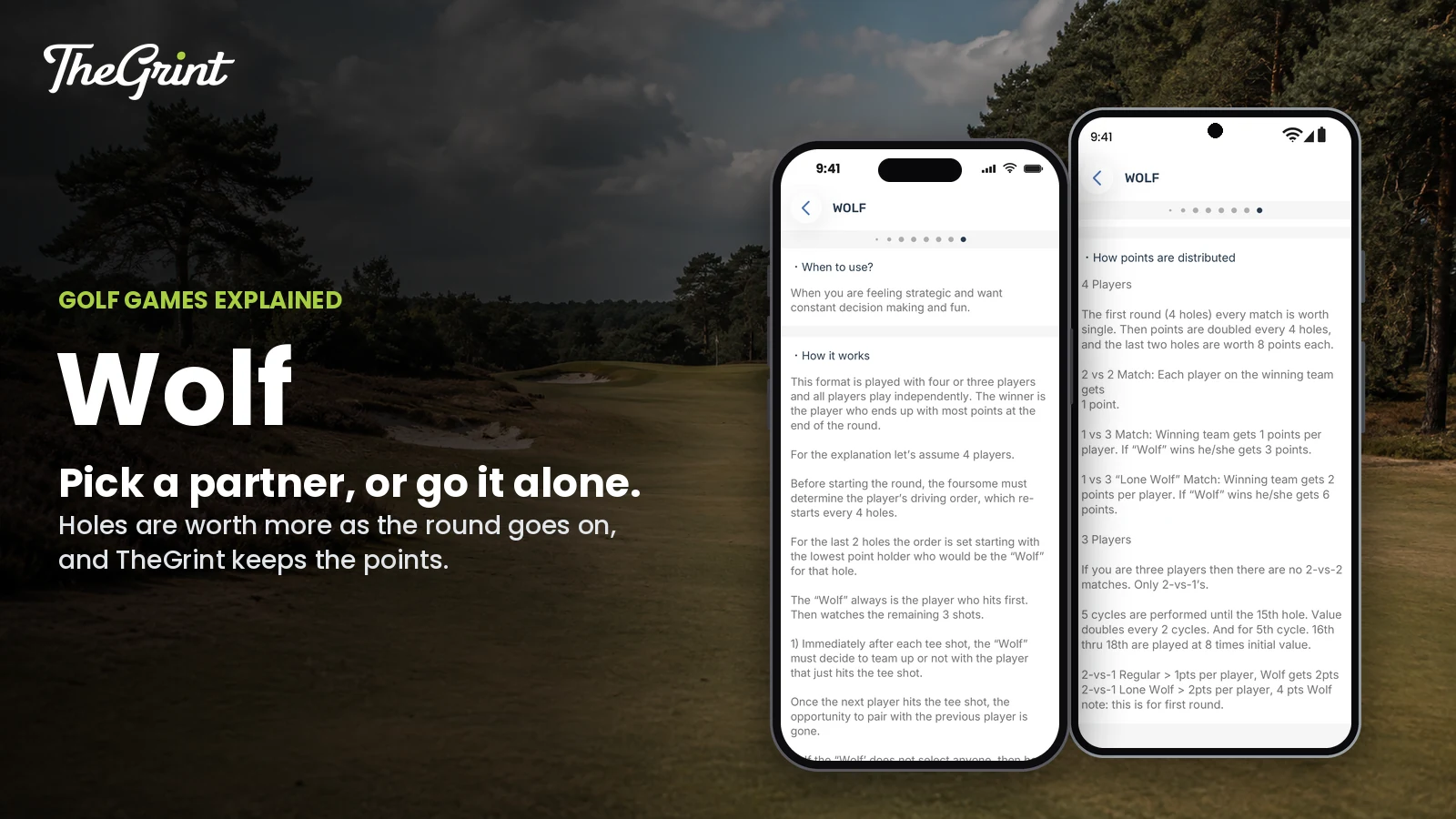
The Wolf golf game is a points game for three or four golfers. On each hole one player is the Wolf, tees off first, and decides after each tee shot whether to take that golfer as a partner or play alone against the group. The winning side earns points, and holes are worth more as the round goes on.
This guide covers the rules step by step, how points are scored, what each hole is worth, a four-hole example, the three-player version, handicaps and strategy.
If you'd rather not keep the math on a scorecard, TheGrint scores Wolf for you as you enter each hole. It is one of the five games a Pro Membership on TheGrint adds to the six free games.
Wolf is a golf game in which the player called the Wolf picks a partner, or decides to go it alone, one tee shot at a time. Each hole becomes either two against two or one against the rest, and the side that wins the hole collects the points.
Everyone plays their own ball and counts every stroke, so Wolf sits on top of a normal round. What changes is who you are playing with. Your partner on one hole can be your opponent on the next, and the Wolf has to decide on each player before seeing the tee shots that come after.
That is what makes the game. Pick a partner too early and a better drive might follow. Wait too long and you may be left to play alone. Because hole values rise late in the round, the last few decisions usually decide who wins.
You play Wolf by rotating the Wolf role through a set driving order, letting the Wolf choose a partner right after each tee shot, and scoring each hole as a team match. These are the rules as TheGrint's app sets them out for four players:
Every player plays their own ball on every hole. The Wolf's choices only decide who is on which side when the scores are compared.
In Wolf, every player on the side that wins the hole earns points, and the Wolf earns more for beating the group alone. In a two-against-two hole, each side's best ball, its lowest score on the hole, is the score that counts. When the Wolf plays alone, it is the Wolf's score against the other three.
Here are the base points for a four-player game, before the hole value is applied:
| How the hole is played | If the Wolf's side wins | If the other side wins |
|---|---|---|
| 2 vs 2 (Wolf picks a partner) | Wolf 1, partner 1 | 1 point to each of the two players |
| 1 vs 3 (Wolf picks nobody) | Wolf 3 | 1 point to each of the three players |
| 1 vs 3, Lone Wolf called before anyone else hits | Wolf 6 | 2 points to each of the three players |
The pattern is simple: playing alone pays the Wolf one point for each opponent, and calling Lone Wolf before seeing any other tee shot doubles everything on that hole, for the Wolf and for the other three.

Each hole in Wolf starts at single value, and the value doubles every four holes, so late holes are worth far more than early ones. In TheGrint's four-player version, the value reaches 8 times the starting value on hole 13 and stays there through the last two holes.
| Holes | Value | 2 vs 2 win, per player | Wolf wins alone | Lone Wolf wins |
|---|---|---|---|---|
| 1–4 | ×1 | 1 | 3 | 6 |
| 5–8 | ×2 | 2 | 6 | 12 |
| 9–12 | ×4 | 4 | 12 | 24 |
| 13–16 | ×8 | 8 | 24 | 48 |
| 17–18 | ×8 | 8 | 24 | 48 |
The rising values keep everyone in the game. A player who is behind after the front nine can catch up with one good Lone Wolf hole on the back nine, and the lowest point holder is the Wolf on the final two holes.
On a scorecard, a Wolf game is tracked hole by hole: note who the Wolf was, who they picked (or Lone Wolf), which side won, and the points each player earned. Here are the first four holes for Alex, Ben, Carla and Dev. Their driving order is Alex, Ben, Carla, Dev, so each of them is the Wolf, and tees off first, once in holes 1 to 4:
| Hole | Wolf | Decision | Scores that count | Result | Alex | Ben | Carla | Dev |
|---|---|---|---|---|---|---|---|---|
| 1 | Alex | Picks Carla | Alex/Carla 4, Ben/Dev 5 | Wolf side wins | 1 | 0 | 1 | 0 |
| 2 | Ben | Picks nobody | Ben 3; others 4, 5, 5 | Wolf wins alone | 0 | 3 | 0 | 0 |
| 3 | Carla | Calls Lone Wolf | Carla 5; others 4, 4, 4 | Other three win | 2 | 2 | 0 | 2 |
| 4 | Dev | Picks Alex | Dev/Alex 4, Ben/Carla 3 | Other side wins | 0 | 1 | 1 | 0 |
| Total | 3 | 6 | 2 | 2 |
After four holes Ben leads with 6 points, half of them from beating the group alone on hole 2. Carla's Lone Wolf call on hole 3 lost her no points, but it handed 2 points to each of the other three.
Now the values climb. A Lone Wolf win, worth 6 points on holes 1 to 4, is worth 12 on holes 5 to 8, 24 on holes 9 to 12, and 48 from hole 13 on. Ben's early lead can disappear on one hole.
With three players, every hole in Wolf is two against one, because there is no way to split three golfers into two pairs.
Three-player Wolf keeps a threesome competitive on every hole, because one player is always outnumbered and has to beat the other side's better score.
Wolf can be played gross, with no handicap strokes, or net, where players subtract the strokes they receive on each hole before the scores are compared. Net play lets golfers of different abilities be useful partners and dangerous Lone Wolves.
Net strokes start from each golfer's Course Handicap™, which the USGA® describes as "the number of strokes needed to play to par of the tees being played" (USGA handicapping FAQs). Our guide to what a golf handicap is explains how a Handicap Index® becomes a Course Handicap. TheGrint offers two handicap formats for net games:
Net Wolf changes the decisions too. A golfer who receives a stroke on a hard hole can be the best partner on the tee even after an average drive, so a smart Wolf checks the stroke index on the scorecard before passing on anyone.
The best Wolf strategy is to take a strong partner when the hole is worth little, save your Lone Wolf moves for when you are clearly the best player on the hole, and watch the point totals as the values climb.
Wolf is one of the five games a Pro Membership on TheGrint adds to the six free games, and the app keeps every player's points current as scores are entered hole by hole, so nobody has to do the math on the cart.
Wolf on TheGrint is scored in points: each hole adds points to the winning side, and hole values grow as the round goes on.
For the full lineup, see the games and live leaderboards on TheGrint, the games available to all members, and what Free and Pro include.
You need three or four players to play Wolf. With four, holes are played two against two when the Wolf picks a partner, or one against three when the Wolf plays alone. With three, every hole is two against one. TheGrint's rules are written for four players, where the partner choice changes on every hole.
A Lone Wolf is a Wolf who calls "Lone Wolf" right after their own tee shot, before anyone else hits, and plays the hole alone against everyone else for double points. A Wolf who watches every tee shot and picks nobody also plays alone, but at regular value, so the early call is the bigger risk and the bigger reward.
The Wolf tees off first, then watches the other players hit one at a time. Right after each tee shot, the Wolf can claim that player as a partner. Once the next player tees off, the earlier player can no longer be picked. If the Wolf picks nobody, the Wolf plays the hole alone.
Yes. In TheGrint's version of Wolf, a player who is picked as a partner can refuse the offer and become the Wolf instead, playing against the other two players. It is a bold move, so it usually comes from a player who has just hit a very good tee shot.
On the last two holes, the driving order starts with the player who has the fewest points, and that player is the Wolf. Because the final holes carry the highest value, this gives the player in last place the best chance to make up ground.
Add your group, start the round, tap Games and pick Wolf, and TheGrint keeps everyone's points current hole by hole, from the first partner pick to the last Lone Wolf call. Wolf comes with a Pro Membership on TheGrint. Get TheGrint.
Handicap Index®, Course Handicap™ and related marks are owned or licensed by the United States Golf Association® (USGA®) and/or The R&A. All rights reserved.


