



TheGrint HQ

6 minutes
Updated
November 9, 2026
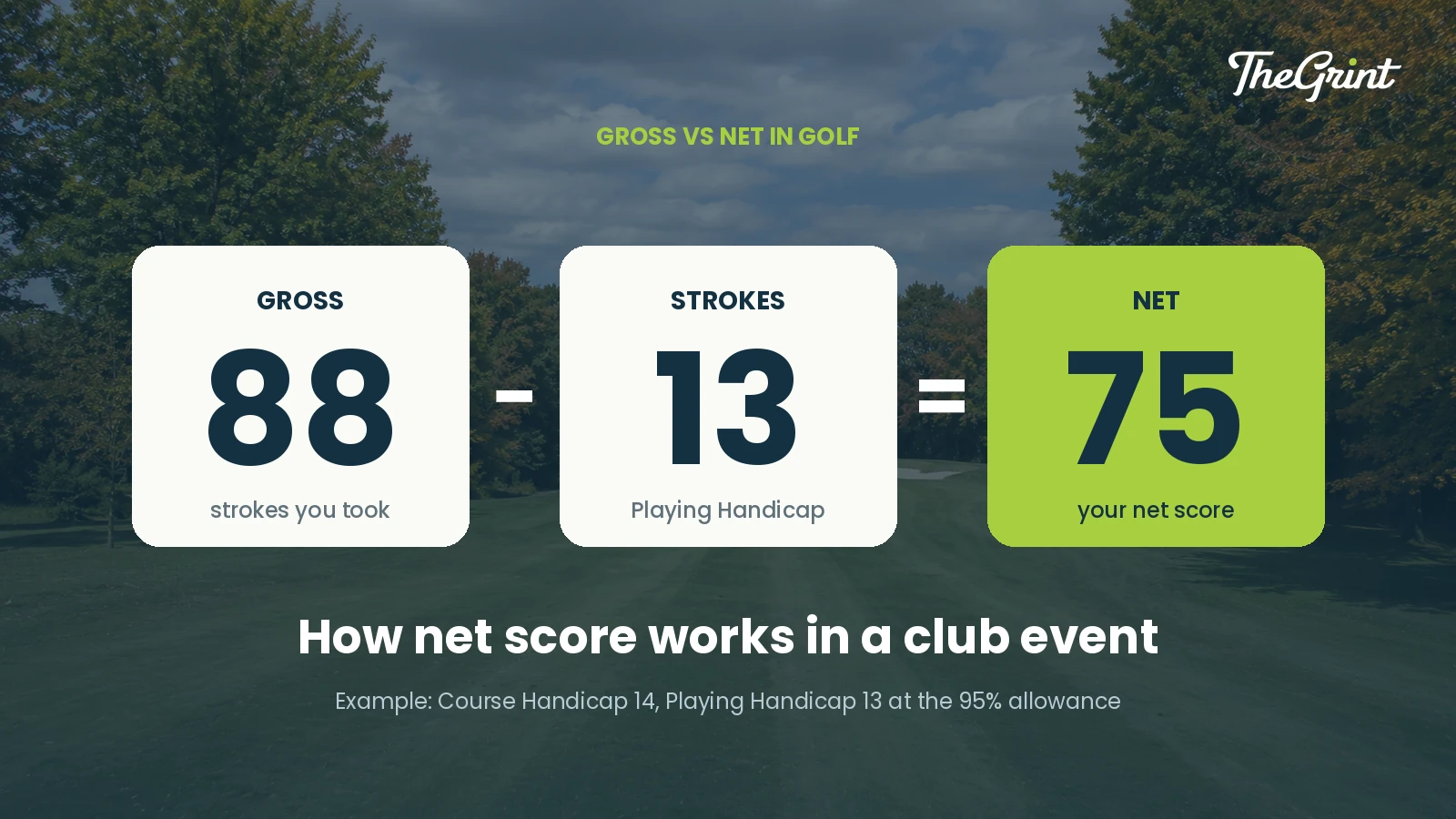
Gross score is the total number of strokes you take in a round. Net score is your gross score minus the handicap strokes you receive, which lets golfers of different abilities compete fairly. In a club event, you subtract your Playing Handicap™ from your gross score, and the lowest net score wins the net prize.
This guide explains the difference, shows how a Course Handicap™ becomes strokes on each hole, works through a full 18-hole example, and covers when to use gross or net in your own event.
Gross score is every stroke you took, including penalties, before any handicap is applied. Net score is that same total after you subtract your handicap strokes. Gross measures raw performance, and net measures performance against your handicap.
| Gross score | Net score | |
|---|---|---|
| What it is | Total strokes taken | Gross score minus handicap strokes received |
| Handicap needed? | No | Yes |
| Who it favors | The best players | Higher-handicap players |
| Best for | Groups with similar ability | Mixed-handicap groups |
| Winner | Lowest gross | Lowest net |
A scratch golfer who shoots 76 has a gross 76 and a net 76. A golfer with 13 strokes who shoots 88 has a gross 88 and a net 75, so the second golfer wins the net prize even though the first played better golf.
To calculate a net score, subtract your Playing Handicap from your gross score: net score = gross score − Playing Handicap. Your Playing Handicap is your Course Handicap adjusted for the handicap allowance the event uses, rounded to a whole number.
For example, a golfer with a Course Handicap of 14 in an individual stroke-play event at 95% has a Playing Handicap of 13 (14 × 0.95 = 13.3, rounded). If that golfer shoots 88, the net score is 75. To see where a Handicap Index comes from, read what a golf handicap is.
Handicap strokes are given on the holes with the lowest stroke index numbers first: a Playing Handicap of 13 gives one stroke on each hole with a stroke index from 1 to 13. The stroke index ranks the holes on the scorecard, and stroke index 1 is where a stroke is given first.
When a player receives more than 18 strokes, the order repeats, so a second stroke goes on stroke index 1 and so on (Rules of Handicapping, Appendix E). The table below runs the 88 from the example through a Playing Handicap of 13:
| Hole | Par | Stroke index | Gross score | Strokes received | Net score |
|---|---|---|---|---|---|
| 1 | 4 | 7 | 5 | 1 | 4 |
| 2 | 4 | 11 | 5 | 1 | 4 |
| 3 | 3 | 15 | 4 | 0 | 4 |
| 4 | 5 | 1 | 7 | 1 | 6 |
| 5 | 4 | 9 | 5 | 1 | 4 |
| 6 | 4 | 3 | 6 | 1 | 5 |
| 7 | 3 | 17 | 3 | 0 | 3 |
| 8 | 5 | 5 | 6 | 1 | 5 |
| 9 | 4 | 13 | 5 | 1 | 4 |
| Out | 36 | 46 | 7 | 39 | |
| 10 | 4 | 8 | 5 | 1 | 4 |
| 11 | 4 | 12 | 4 | 1 | 3 |
| 12 | 3 | 16 | 4 | 0 | 4 |
| 13 | 5 | 2 | 6 | 1 | 5 |
| 14 | 4 | 10 | 5 | 1 | 4 |
| 15 | 4 | 4 | 5 | 1 | 4 |
| 16 | 3 | 18 | 4 | 0 | 4 |
| 17 | 5 | 6 | 6 | 1 | 5 |
| 18 | 4 | 14 | 3 | 0 | 3 |
| In | 36 | 42 | 6 | 36 | |
| Total | 72 | 88 | 13 | 75 |
The golfer's gross 88 becomes a net 75 because 13 holes (those with stroke index 1 to 13) each lose one stroke. The five holes with stroke index 14 to 18 are played at gross.
No. Net double bogey is the maximum score you can count on a single hole for handicap purposes, while net score is your total for the round after handicap strokes. Net double bogey equals par plus two strokes, plus any handicap strokes you receive on that hole (Rules of Handicapping, Definitions).
For example, on a par 4 where you receive one stroke, net double bogey is 7 (4 + 2 + 1). A 9 on that hole is entered as a 7 for handicap purposes. The strokes for net double bogey come from your Course Handicap.
Use gross scoring when the players are close in ability, and use net scoring when handicaps vary widely. Most club events run both, with a gross prize for the best raw score and a net prize for the best score against handicap.
For a group with a wide mix of handicaps, golf games for different handicaps lists formats that stay fair, and how to organize a golf tournament covers the full setup, including prizes.
TheGrint's Leaderboard has Net Score and Gross Score views.
Games on TheGrint are points-based.
Neither is better; they answer different questions. A gross score shows how well you played the course, while a net score shows how well you played relative to your handicap. Low gross decides who played the best golf, and low net decides who beat their own standard on the day.
Yes. Net score is gross minus the strokes you receive, so a golfer who shoots 88 with 13 strokes finishes on a net 75, which is 3 over par on a par 72 course. A higher-handicap golfer who plays well can finish net under par even with a gross score well over it.
Yes. Without handicap strokes there is nothing to subtract, so your net score would simply equal your gross score. A group can use an official Handicap Index or an agreed estimate, but the whole field should use the same method so the net result is fair.
No. Your Handicap Index is built from your adjusted gross scores, not from net scores. Net score is how a single competition applies your handicap on the day; it does not feed back into the calculation.
Most club events award both: a gross prize for the lowest raw score and a net prize for the lowest score after handicap strokes. The Committee sets which prizes apply in the Terms of the Competition, and a player usually cannot win both if the event says so.
Set up a Leaderboard for your next event and switch between Net Score and Gross Score views. Get TheGrint.
Handicap Index®, Course Handicap™, Playing Handicap™, Slope Rating™, Course Rating™ and related marks are owned or licensed by the United States Golf Association® (USGA®) and/or The R&A. All rights reserved.


