



TheGrint HQ

12 minutes
Updated
November 9, 2026
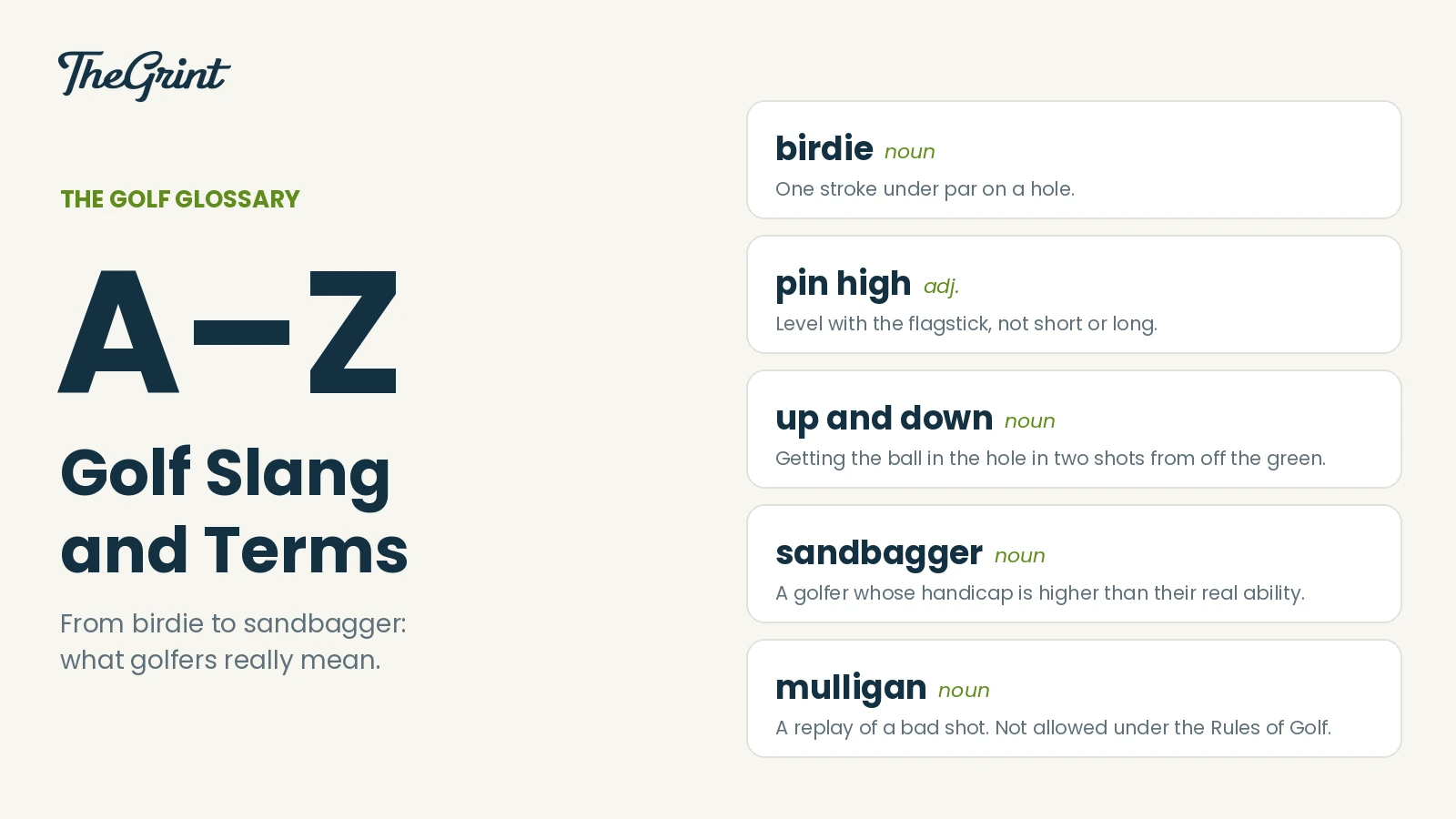
Golf slang is the shorthand golfers use on the course: scoring words like birdie and bogey, shot names like slice and chip, course terms like fringe and dogleg, and nicknames for the people you play with. This glossary explains more than 80 golf terms in plain English, grouped by topic so you can find any word fast.
Whether you are new to the game or just tired of nodding along, you will find every common golf term here in one line each. TheGrint tracks your scores, stats and handicap, so these words show up in your own rounds, too.
In this guide:
Golf slang is the informal vocabulary golfers use to describe scores, shots, courses and each other. Some terms are official, such as par and bogey, and some are nicknames, such as snowman or worm burner. Many golf words have more than one name, which is why the same idea can sound different at different courses.
Each section below is a table you can scan. Terms are listed alphabetically within each group, and anything that has its own full guide links out to it.
Scoring terms describe how many strokes you took compared with par. Par is the baseline, and most scoring words are just a name for a number above or below it. The table below lists them alphabetically.
| Term | Meaning |
|---|---|
| Ace | A hole in one: getting the ball in the cup with your tee shot. Also the name for any score of 1 on a hole. |
| Albatross | A score of three under par on a hole, such as a 2 on a par 5. Also called a double eagle. |
| Birdie | A score of one under par on a hole, such as a 3 on a par 4. |
| Bogey | A score of one over par on a hole, such as a 5 on a par 4. |
| Bogey golf | Playing a round where you average about one over par a hole, roughly a score of 90 on a par 72 course. |
| Break 80 / 90 / 100 | Shooting a round score under that number for the first time, such as 79 or lower to break 80. A common milestone goal. |
| Condor | A score of four under par on a hole, such as a hole in one on a par 5. It is extremely rare. |
| Double bogey | A score of two over par on a hole, such as a 6 on a par 4. |
| Eagle | A score of two under par on a hole, such as a 3 on a par 5. |
| Gross score | Your actual number of strokes for a hole or a round, before any handicap strokes are taken off. |
| Mulligan | A free do-over of a shot, usually the tee shot, allowed in casual rounds when the group agrees. |
| Net score | Your gross score minus the handicap strokes you receive, used to compare golfers of different abilities. |
| Par | The number of strokes a good golfer is expected to need on a hole or a course. Most holes are par 3, 4 or 5. |
| Sandie | Getting up and down from a bunker: your shot out of the sand and one putt, for a par or better. |
| Snowman | A score of 8 on a single hole, named because the number looks like a snowman. |
| Triple bogey | A score of three over par on a hole, such as a 7 on a par 4. |
| Up and down | Getting the ball into the hole in two strokes from near the green: one chip or pitch, then one putt, usually to save par. |
Scores add up fast, so many golfers track them hole by hole. TheGrint's score tracking does that for you on the phone, and a golfer who lines up the numbers and the stats over time can see where the strokes are going.
Shot terms name how the ball leaves the club and where it goes. Most of them describe either a curve, a mishit, or a deliberate type of shot. The directions below assume a right-handed golfer; they flip for a left-hander.
| Term | Meaning |
|---|---|
| Banana ball | A badly curving slice that bends sharply from left to right for a right-handed golfer. |
| Bump and run | A low chip that lands short of the green and rolls toward the hole like a putt. |
| Carry | How far the ball travels in the air before it first lands, not counting any roll. |
| Chili dip | A chunked chip that sticks in the turf and moves only a short way. Also called a chunk or a fat shot. |
| Draw | A controlled shot that curves gently from right to left for a right-handed golfer. |
| Duff | A badly mishit shot, often one where the club hits the ground well before the ball. |
| Fade | A controlled shot that curves gently from left to right for a right-handed golfer. |
| Flop shot | A high, soft shot played with an open clubface that lands softly and stops quickly. |
| Fore | The warning golfers shout when a ball may be heading toward other people. |
| Hook | A shot that curves sharply from right to left for a right-handed golfer, usually unintentionally. |
| Lay up | To hit a shorter, safer shot on purpose, short of a hazard or a green, instead of going for it. |
| Pin high | A shot that finishes level with the flagstick, even if it is to the left or right of it rather than past it or short. |
| Pull | A shot that starts left of the target and flies straight for a right-handed golfer. |
| Punch shot | A low, controlled shot played with a shorter swing, often to keep the ball under trees or out of the wind. |
| Push | A shot that starts right of the target and flies straight for a right-handed golfer. |
| Shank | A shot struck off the hosel of the club that shoots sharply to the right. Also called a hosel rocket. |
| Skull | Hitting the ball with the bottom edge of the club so it flies low and fast, often over the green. Also called a blade. |
| Slice | A shot that curves sharply from left to right for a right-handed golfer, usually unintentionally. |
| Stinger | A low, penetrating shot with a long iron or fairway wood that stays under the wind. |
| Texas wedge | Using a putter from off the green, such as from the fringe or the fairway. |
| Top | Hitting the upper half of the ball so it rolls along the ground instead of flying. |
| Whiff | Swinging and missing the ball completely, also called an air shot. It counts as a stroke. |
| Worm burner | A low shot that skims along the ground without leaving it. |
| Yips | An involuntary twitch or loss of nerve, most often in putting, that makes short strokes hard. |
Course terms name the parts of the golf course, from the tee box to the cup, and the way the ball sits and rolls on them. Knowing them makes yardage books, scorecards and course descriptions much easier to read.
| Term | Meaning |
|---|---|
| Apron | The short grass between the fairway and the green. See also fringe. |
| Back nine | Holes 10 through 18 on an 18-hole course. |
| Break | How much a putt curves because of the slope of the green. |
| Bunker | A sand-filled hazard. Often called a sand trap, though bunker is the standard term. |
| Dance floor | A casual nickname for the green. |
| Dogleg | A hole that bends to the left or right, like a dog's hind leg. |
| Fairway | The closely mown grass between the tee and the green, the best place to play your next shot from. |
| First cut | The slightly longer grass bordering the fairway, between the fairway and the rough. |
| Fringe | The short, collar-like grass surrounding the green, also called the collar. |
| Front nine | Holes 1 through 9 on an 18-hole course. |
| Gimme | A short putt that playing partners agree you can pick up without hitting, counted as holed in casual play. |
| Green | The smooth, closely mown area around the hole where you putt. |
| Green in regulation (GIR) | Reaching the green in two strokes fewer than par: one on a par 3, two on a par 4, three on a par 5. |
| Hardpan | Bare, packed dirt with little or no grass, which can make for a tricky lie. |
| Hazard | An area such as water or a bunker that makes the hole harder to play. |
| Lag putt | A long putt where the goal is to leave the ball close to the hole, not to make it. |
| Lie | The position of the ball on the ground and how easy it is to hit, as in a good lie or a bad lie. |
| Lip out | When the ball hits the edge of the cup and spins out instead of dropping in. |
| Links | A coastal course, traditionally with sandy soil, firm ground and few trees. |
| Out of bounds (OB) | The area outside the course where play is not allowed, usually marked by white stakes or lines. |
| Pin | The flagstick marking the hole. Also called the flag. |
| Plugged lie | A ball that has buried itself in its own pitch mark, usually in sand or soft turf. |
| Rough | The longer grass beside the fairway and around the green. |
| Stimpmeter | A device used to measure how fast a green rolls, which is why people talk about fast and slow greens. |
| Tee box | The area where you start each hole, often marked with different colored tees for different distances. |
| Three-putt | Taking three putts to get the ball into the hole from the green. |
For more on one of the most-used terms in the table, see what GIR means in golf. When you want distances to the front, middle and back of the green, TheGrint's golf GPS shows them on the hole map, and GPS maps and distances are free.
This group covers the nicknames for different kinds of golfers and the formats groups play. Formats change how a score is counted, so it pays to know what you are signing up for before the first tee.
| Term | Meaning |
|---|---|
| All square | A tied match in match play. |
| Best ball | A format where each golfer plays their own ball, and the team uses the best score on each hole. |
| Caddie | A person who carries the bag and gives advice during a round. |
| Dormie | In match play, being as many holes ahead as there are holes left, so you cannot lose the match. |
| Duffer | A casual term for a golfer who struggles, usually said with affection. |
| Fourball | A format for two teams of two, where each golfer plays their own ball and the better score on each hole counts for the team. |
| Foursome | A group of four golfers. In formal play, it can also mean a format where partners alternate shots with one ball. |
| Hacker | A golfer who hits the ball in all directions and scores high. |
| Honors | The right to tee off first on a hole, earned by having the lowest score on the previous hole. |
| Marshal | A course employee who helps keep play moving and checks on groups. |
| Match play | A format where you win a hole by taking fewer strokes than your opponent, and the match goes to whoever wins more holes. |
| Playing partner | Anyone else in your group. |
| Sandbagger | A golfer whose handicap is higher than their real ability, which gives them an unfair edge in net scoring. |
| Scramble | A team format where everyone hits, the team picks the best shot and everyone plays from there. |
| Scratch golfer | A golfer with a handicap of zero, who is expected to play to the rating of the course. |
| Stableford | A points format in which each hole earns points based on your score relative to par, and the highest total wins. |
| Stroke play | The most common format: add up all your strokes and the lowest total wins. |
Two of these have full guides: how Stableford scoring works and best ball versus scramble. TheGrint's golf games score a round for you, with 6 core games on Free and 11 on Pro.
Handicap terms describe the numbers that let golfers of different abilities play on level terms. They are the most precise words in golf because they have exact definitions, so they are worth getting right.
TheGrint is free, always, and is trusted by millions of golfers. It is a golf app that puts the words in this glossary to work in your own rounds.
Golf slang is the informal language golfers use for scores, shots, courses and players, such as birdie, slice, fringe and hacker. Some of it is official vocabulary and some is nicknames golfers made up. This glossary explains the most common golf terms and meanings in one line each, grouped by topic.
A birdie is one stroke under par on a hole, an eagle is two under par, and a bogey is one over par. A double bogey is two over par. Par is the number of strokes a good golfer is expected to take on that hole, usually 3, 4 or 5.
A slice curves sharply from left to right and a hook curves sharply from right to left, both for a right-handed golfer. Both are usually unintended, and they are mirrored for left-handers. A controlled version of each is called a fade or a draw.
Playing to your handicap means shooting a net score of par: your gross score equals par plus your handicap strokes. A golfer with a Course Handicap of 10 on a par 72 course plays to their handicap by shooting 82. Playing better than that is playing below your handicap.
Fore is the warning golfers shout when a ball may be heading toward other people. Shout it loudly and right away, even if you think the ball is unlikely to hit anyone. It applies to any shot that may reach another player, spectator or course worker.
A mulligan is a free do-over of a shot, usually the opening tee shot. It is a casual-round custom, so it only applies when everyone in your group agrees to it. Because it is informal, check with your group before you take one.
Post each round hole by hole and TheGrint turns the words above into your own numbers: scores, stats and an estimated handicap. For more advanced features, try TheGrint Pro free for 7 days. Get started with TheGrint.
Handicap Index®, Course Handicap™, Course Rating™, Slope Rating™ and related marks are owned or licensed by the United States Golf Association® (USGA®) and/or The R&A. All rights reserved.


